

The telecommunications sector is undergoing an unprecedented architectural transformation. The rapid global expansion of 5G standalone networks, massive Internet of Things (IoT) deployments, edge computing architectures, and subscriber demand for hyper-personalized digital experiences are radically altering operational requirements. For Communication Service Providers (CSPs), Mobile Virtual Network Operators (MVNOs), and Mobile Virtual Network Enablers (MVNEs), traditional Business Support Systems (BSS) are no longer capable of keeping pace with modern commercial demands.
Historically built on rigid, on-premises infrastructure, legacy BSS environments were engineered for predictable voice and SMS traffic with long product development cycles. Today, however, these monolithic stacks create severe operational bottlenecks, demand astronomical maintenance expenditures, and prolong product rollout timelines from days to months. As operators pivot toward non-traditional revenue models, such as network slicing, dynamic enterprise SLAs, B2B2X partner marketplaces, and digital lifestyle bundles, the cloud BSS platform has emerged as the single most critical asset in the telecom technology stack.
The 9 Core Cloud BSS Platform Capabilities
To help CSPs, MVNOs, and MVNEs navigate BSS modernization, we examine the nine fundamental platform capabilities required to future-proof telecom operations for the next decade.
1. Cloud-Native & Microservices-Based Architecture
The cornerstone of a resilient cloud BSS platform is a cloud-native, microservices-based architecture built from the ground up rather than legacy software re-hosted inside virtual machines.
- Containerization & Orchestration: Core BSS functions, such as rating, catalog management, billing, and customer care, are decomposed into lightweight, isolated containerized microservices.
- Elastic Auto-Scaling: During unexpected traffic surges, promotional recharges, or high-volume enterprise events, the platform automatically allocates compute and memory resources to specific microservices without requiring full-system over-provisioning.
- Continuous Delivery (CI/CD): Microservices allow development teams to update, patch, or enhance individual functional modules independently, eliminating maintenance windows and platform downtime.
- Multi-Cloud Deployment Flexibility: A true cloud BSS platform operates seamlessly across public cloud providers (AWS, Azure, Google Cloud), private clouds, or hybrid cloud environments, protecting operators against vendor lock-in.
For MVNOs and MVNEs competing on thin margins, elastic scalability ensures infrastructure spending directly tracks active subscriber usage, turning fixed capital investments into variable operational expenses.
2. Real-Time BSS Mediation & Convergent Charging System (OCS/CHF)
Legacy billing architectures relied heavily on delayed batch processing, where raw network event detail records (EDRs/CDRs) were processed hours or days after usage occurred. Modern 5G and IoT monetization mandates low-latency processing.
- Real-Time BSS Mediation: Functions as an intelligent abstraction layer that ingests, correlates, normalizes, and enriches raw telemetry and network event streams from diverse network domains (4G EPC, 5G Core, IMS, IoT gateways) in sub-milliseconds.
- 5G CHF Integration: Aligns natively with 3GPP Service-Based Architecture (SBA) standards, enabling real-time monetization of 5G network slicing, quality-of-service (QoS) guarantees, and ultra-reliable low-latency communication (URLLC) sessions.
- Convergent Charging Engine: Unifies prepaid, postpaid, enterprise, and hybrid subscriber accounts under a single rating engine. Read our detailed analysis on Online Charging Solutions in Telecom to see how sub-millisecond rating powers 5G business models.
- Revenue Leakage Prevention: Instantaneous credit control prevents balance overruns, credit shock, and bill disputes, ensuring zero unbilled usage across prepaid and postpaid customer tiers.
6D Technologies’ Canvas platform embeds high-throughput mediation directly within its convergent charging environment, eliminating legacy mediation handoffs and speeding up transaction processing.
3. Dynamic, Centralized Product Catalog with Low-Code/No-Code Configuration
In saturated mobile markets, commercial speed-to-market is a primary differentiator. Legacy platforms required extensive custom code changes and vendor professional services to introduce even minor tariff adjustments.
- Centralized Commercial Catalog: Serves as the single source of truth for all products, tariff plans, add-ons, discounts, and enterprise service bundles across retail, B2B, and partner channels.
- Low-Code/No-Code Drag-and-Drop Builders: Product managers and commercial teams can design, test, and launch complex offers using visual workflows, pre-built templates, and business rules without writing custom code.
- Rapid Commercial Rollouts: Reduces offer creation timelines from 3–6 months down to hours or days, enabling commercial teams to quickly counter competitive campaigns, launch seasonal promotions, or roll out personalized enterprise packages.
- Dynamic Bundling Capabilities: Allows operators to bundle traditional telecom utilities (data, voice, SMS) with non-telecom digital services (video streaming, cloud storage, fintech wallets, gaming subscriptions) under flexible pricing arrangements.
4. Embedded AI and Machine Learning for Hyper-Personalization
Artificial intelligence and machine learning have evolved from optional analytics add-ons into fundamental operational layers embedded directly inside modern cloud BSS platforms.
- 360-Degree Subscriber Intelligence: Synthesizes real-time usage data, billing histories, interaction logs, and customer preferences into dynamic subscriber profiles.
- Predictive Churn Management: AI algorithms identify early indicators of subscriber dissatisfaction or behavioral shifts, triggering automated retention workflows before churn occurs.
- Next-Best-Offer (NBO) Recommendations: Real-time engines evaluate subscriber context (location, remaining account balances, current application usage) to deliver contextually relevant offer prompts across digital self-service channels.
- Embedded Intelligence Layer: Systems like 6D Technologies’ Magik AI & Analytics Suite continuously monitor transactional traffic, automate administrative tasks, and optimize customer lifetime value (LTV).
5. Automated Order Management & End-to-End Service Orchestration
As service complexity increases, manual order processing leads to order drops, fulfillment delays, and inflated support costs. Cloud BSS platforms automate order fulfillment from digital storefronts to network activation.
- Catalog-Driven Order Decomposition: Automatically translates commercial orders into precise technical action plans, coordinating multi-step provisioning steps across OSS and network domains.
- eSIM & Remote SIM Provisioning: Supports instant, zero-touch activation for smartphones, wearables, connected vehicles, and enterprise IoT fleets.
- Digital Identity Verification (e-KYC): Integrates automated biometric validation, document scanning, and fraud background checks into the onboarding sequence, ensuring regulatory compliance within minutes.
- Automated Exception & Error Handling: Monitors order state transitions in real time, automatically correcting transient network failures or re-routing failed provisioning requests to minimize customer dropped orders.
6. Open API Architecture & TM Forum Standards Compliance
Modern operators must participate in broader digital partner ecosystems. An isolated cloud BSS platform limits commercial opportunities and creates integration friction.
- RESTful Open APIs: Expose platform capabilities through standardized interfaces compliant with TM Forum Open API Standards (e.g., TMF620 Product Catalog, TMF622 Product Ordering, TMF676 Payment Management).
- Ecosystem Connectivity: Simplifies integrations with external payment gateways, fintech applications, mobile wallets, OTT content partners, digital marketplaces, and enterprise ERP systems.
- Decoupled Frontend/Backend (Headless Architecture): Enables operators to construct custom mobile apps, web portals, or conversational sales interfaces without modifying underlying core cloud BSS platform logic.
- Vendor Lock-In Elimination: Standardized API abstractions ensure operators can swap, update, or integrate third-party tools, OSS platforms, or legacy infrastructure components without risking system-wide instability.
7. Integrated Revenue Assurance & Automated Fraud Management
Revenue leakage and cyber-enabled fraud remain significant threats to telecom margins. Cloud BSS platforms integrate real-time protection directly into core mediation and billing workflows.
- Real-Time Record Reconciliation: Continuously compares network-generated usage records (EDRs/CDRs) against mediation and rating logs to detect unbilled usage, pricing misconfigurations, or network drop-offs instantly.
- Automated Fraud Detection: Machine learning models monitor usage anomalies in real time, flagging SIM farming, International Revenue Share Fraud (IRSF), bypass fraud, and account takeover attempts before financial damage scales.
- Configurable Audit Trails: Maintains immutable, time-stamped ledger entries across billing events, manual account adjustments, and financial settlements, simplifying compliance with internal financial controls and external regulatory audits.
8. Multi-Tenant, Elastic Scalability & Hybrid Cloud Deployment
For MVNEs, sub-brand operators, and multi-national telecom groups, managing separate cloud BSS platform instances for every brand or market drives up platform overhead and operational complexity.
- Strict Logical Data Isolation: A single cloud BSS platform installation supports multiple independent brands, MVNO partners, or regional operating companies while maintaining complete data isolation, regulatory privacy, and strict access controls.
- Customizable Tenant Branding & Catalog Logic: Enables each tenant to independently configure pricing catalogs, customer care flows, billing invoice templates, and promotional campaigns without affecting neighboring tenants.
- Centralized Operational Governance: Provides group-level IT teams or MVNE operators with a unified dashboard to manage infrastructure usage, core software updates, compliance rules, and partner settlement models across all tenant accounts.
- Resource Efficiency: Shared underlying infrastructure dramatically reduces total cost of ownership (TCO) for new brand launches, allowing MVNEs to onboard emerging MVNO partners within days.
9. Built-In Security, Data Sovereignty, and Regulatory Compliance
As data protection mandates (e.g., GDPR, local data residency laws) become stricter across international jurisdictions, cloud BSS platforms must prioritize regulatory compliance by design.
- Granular Role-Based Access Control (RBAC): Enforces strict data access rules across customer support, finance, administration, and external vendor teams.
- End-to-End Data Encryption: Protects personally identifiable information (PII), credit details, and network usage records both at rest and in transit across all cloud BSS platform microservices.
- Configurable Data Residency Controls: Supports flexible deployment topologies, enabling operators to maintain subscriber data locally within national borders while using global cloud infrastructure for non-sensitive application tasks.
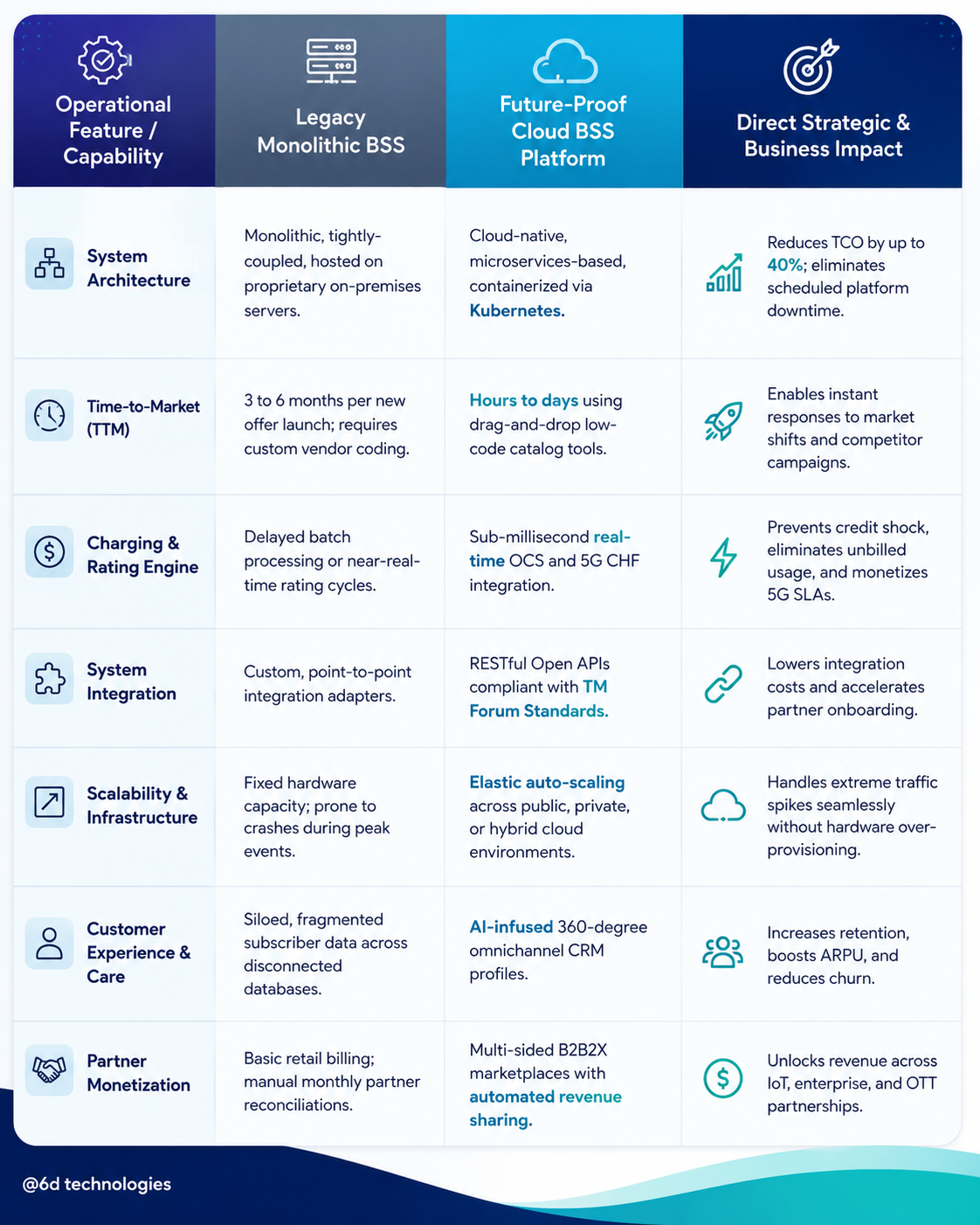
Legacy Monolithic BSS vs. Future-Proof Cloud BSS Platform
To highlight the operational impact of BSS modernization, the table below compares legacy monolithic BSS architectures against a modern, cloud BSS platform solution:
Strategic Business Value & Return on Investment (ROI)
Investing in a modern cloud BSS platform delivers tangible operational and commercial benefits:
1. Accelerated Revenue Growth
By shortening product deployment cycles from months to hours, operators can capture emerging market opportunities ahead of competitors. Low-code catalog tools allow commercial teams to test niche pricing plans, experiment with temporary promotional bundles, and capitalize on 5G B2B enterprise opportunities without incurring heavy software development costs.
2. Operational Expense (OPEX) and CAPEX Efficiency
Cloud-native auto-scaling eliminates the need to purchase, maintain, and power over-provisioned hardware designed solely for peak traffic events. Unified microservices suites reduce ongoing IT maintenance expenditures, streamline software updates, and cut operational costs by up to 40%.
3. Margin Protection and Zero Revenue Leakage
Real-time mediation coupled with sub-millisecond convergent charging ensures every network event, whether voice, data, messaging, or IoT telemetry, is rated and billed instantly. Automated reconciliation algorithms continuously match network logs against charging engines, protecting margins against unbilled usage and rating errors.
4. Higher Subscriber Lifetime Value (LTV) and Churn Reduction
AI-driven hyper-personalization engines empower operators to deliver targeted Next-Best-Offer (NBO) recommendations and proactive retention actions right when subscribers are most engaged. Frictionless digital self-service capabilities increase customer satisfaction, improve Net Promoter Scores (NPS), and drive Average Revenue Per User (ARPU) growth.
How 6D Technologies Delivers Future-Ready Operations
6D Technologies delivers a complete cloud-native operational suite through Canvas, its cloud BSS platform. Supported by the AARYA AI layer for intelligent automation and Lynx for digital service orchestration, 6D Technologies provides an end-to-end commercial framework built specifically for CSPs, MVNOs, and MVNEs.
Rather than offering point solutions that require complex integration, 6D Technologies unifies billing, charging, real-time cloud BSS platform mediation, omnichannel customer care, and multi-tenant partner management within an API-first architecture.
Low-Risk, Phased Rollout Methodology
To eliminate operational disruption during modernization, 6D Technologies uses a phased deployment methodology:
- Phase 1: Core Mediation & Charging Activation: High-priority revenue functions, such as a real-time cloud BSS platform, 5G convergent charging, and credit control, go live first to secure rating accuracy and eliminate leakage.
- Phase 2: Customer Lifecycle & Catalog Consolidation: The dynamic product catalog, order management modules, and omnichannel CRM environments are activated to streamline customer onboarding.
- Phase 3: AI Intelligence & Partner Ecosystem Monetization: The AARYA AI layer and multi-tenant B2B2X marketplace tools are deployed, unlocking automated churn management, dynamic fraud detection, and multi-party revenue-sharing workflows.
This modular rollout structure allows operators to realize initial commercial value early while systematically updating core operations without downtime.
Conclusion
Transitioning to a cloud BSS platform is no longer a future-looking technology goal; it is an immediate operational requirement for telecom operators navigating the 5G and IoT era. Monolithic BSS stacks can no longer support the real-time speed, dynamic pricing structures, and partner ecosystems required by modern subscribers and enterprise clients.
Key Takeaways:
- Elastic Cloud-Native Architecture: Containerized microservices allow operators to scale capacity dynamically while reducing infrastructure overhead and OPEX.
- Sub-Millisecond Real-Time Mediation: Low-latency event processing enables true convergent charging across all network domains and subscriber payment types.
- Agile Offer Innovation: Centralized, low-code product catalogs reduce offer design and launch timelines from months to hours.
- Embedded AI Intelligence: Machine learning layers automate churn management, drive personalized recommendations, and detect fraud in real time.
- Open API Ecosystem Connectivity: TM Forum-compliant RESTful APIs remove integration barriers and facilitate B2B2X marketplace expansion.
- Multi-Tenant Governance: Efficient shared-infrastructure capabilities enable MVNEs and sub-brand operators to scale efficiently.
By deploying a cloud BSS platform such as 6D Technologies’ Canvas, operators convert back-office billing systems into agile, intelligent commercial growth engines. Modernizing your BSS stack provides the speed, operational precision, and commercial flexibility needed to lead in the evolving digital communications landscape.
FAQs
What is the difference between a traditional BSS and a cloud BSS platform?
A traditional BSS runs on on-premises infrastructure with tightly coupled monolithic architecture, making upgrades slow, costly, and risky. A cloud BSS platform runs on cloud-native, containerized microservices that scale elastically, integrate through TM Forum Open APIs, and support rapid feature releases without platform downtime.
Why is BSS mediation important for real-time billing accuracy?
BSS mediation collects, correlates, and enriches raw network event data from disparate domains into structured billable transactions. Performing BSS mediation in real time is essential for convergent charging, preventing credit overruns, eliminating revenue leakage, and maintaining billing accuracy across prepaid and postpaid accounts.
How does a converged BSS suite benefit MVNOs and MVNEs?
A converged BSS suite consolidates billing, customer relationship management (CRM), order management, and partner settlement onto a single shared platform. This eliminates the cost of integrating fragmented point solutions, simplifies multi-brand governance, and accelerates brand launches.
What key criteria should telecom operators evaluate when choosing a digital BSS solution?
Operators should evaluate cloud-native auto-scaling capabilities, sub-millisecond convergent charging performance, TM Forum Open API compliance, low-code/no-code catalog configurations, embedded AI automation, multi-tenant capabilities, and the vendor’s track record for phased migrations.
Is migrating to a cloud BSS platform disruptive to existing telecom operations?
A well-architected migration using microservices and an API-first design can be phased to minimize operational risk. Operators can migrate individual functions—such as real-time mediation or catalog management- step-by-step rather than attempting a high-risk rip-and-replace cutover.