
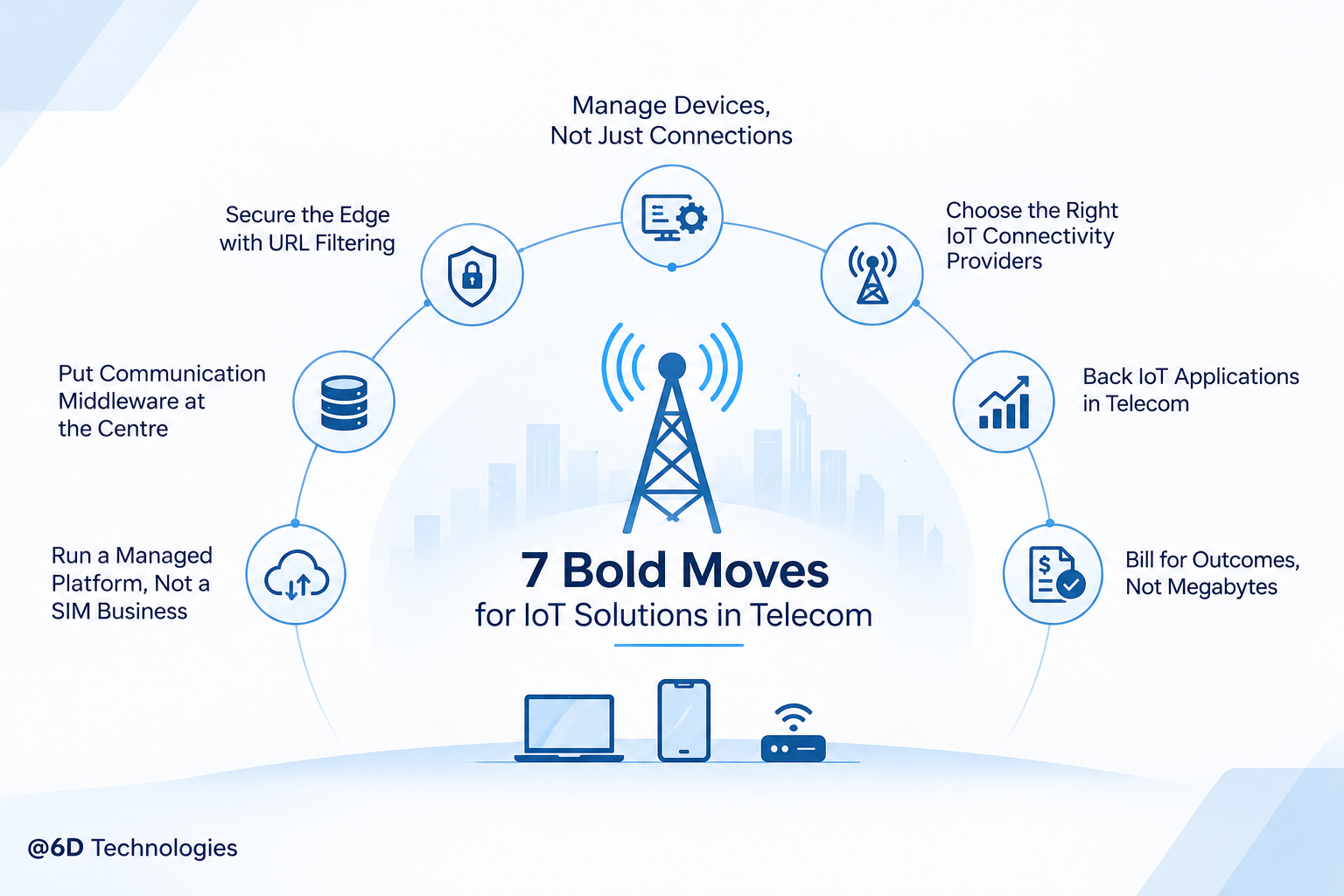
The strongest IoT solutions for telecom industry leaders follow seven bold moves:
- Treat connectivity as a managed service, not a SIM shipment.
- Use communication middleware for IoT between devices and applications.
- Manage every device across its full lifecycle.
- Filter URLs at the device edge.
- Choose among the top IoT connectivity providers on APIs, not coverage alone.
- Back IoT applications in telecom that lift ARPU.
- Bill for outcomes, not megabytes.
Providers such as 6D Technologies, a leader in telecom software, build around these moves. Each move answers a real operator pain point. The sections below explain them in practical terms.
Move 1: Run a Managed Platform, Not a SIM Business
Enterprises not just want raw SIMs. They want reliable connectivity across borders, carriers, and device types. A managed IoT connectivity platform delivers that outcome. It turns a commodity link into a service with clear service levels. Every IoT connectivity management platform should be judged on that promise. That promise defines IoT solutions for telecom industry success.
Scale makes this urgent. IoT Analytics reports 21.1 billion connected IoT devices by the end of 2025. That is 14% growth in a year. It forecasts about 39 billion by 2030. Manual tools cannot handle that volume. Buyers of IoT solutions for telecom industry deployments know it.
What does an AI-driven platform change for an operator? It spots usage spikes before they become bill shock. It suggests policy changes from live traffic patterns. Communication middleware for IoT feeds it clean data. It also flags SIMs that behave like stolen devices. These gains help the top IoT connectivity providers keep enterprise customers.
An IoT connectivity management platform also automates activation and eSIM profile switching. It exposes usage data through APIs. Customers then self-serve instead of raising tickets. The operator keeps the margin and the relationship. That separates durable IoT solutions for telecom industry offers from simple data bundles.
Move 2: Put Communication Middleware at the Centre
Device protocols are messy. MQTT, CoAP, LwM2M, and proprietary formats share the same network. Applications cannot absorb that complexity. Communication middleware for IoT solves this. It normalizes data before it reaches the business layer. It is a quiet pillar of IoT solutions for telecom industry stacks.
An IoT middleware platform sits between devices and enterprise systems. It translates protocols, buffers messages, and enforces security rules. It routes each event to the right analytics or billing function. That is why communication middleware for IoT is a design choice, not an afterthought.
Picture the IoT telecom stack in layers: devices, connectivity, middleware, and applications. Operators that own the middleware layer own the customer workflow. Those that skip it become pipes. A good IoT connectivity management platform feeds the middleware clean subscriber data. Communication middleware for IoT also keeps vendor lock-in low.
An operator-grade IoT middleware platform beats a generic cloud broker here. It understands network events, subscriber context, and charging triggers. That depth is hard to copy. It strengthens any portfolio of IoT solutions for telecom industry buyers. Operators also gain a reusable IoT middleware platform for every new vertical.
Move 3: Manage Devices, Not Just Connections
A connection count says little about device health. One firmware bug can silence thousands of meters overnight. Operators need visibility at the device level, not only at the SIM level. Without an M2M device management platform in IoT devices, support teams are left guessing.
An M2M device management platform in IoT devices handles onboarding, diagnostics, and over-the-air updates. It tracks signal quality, battery state, and last-seen time. It flags anomalies before customers notice them. Fleet and utility IoT applications in telecom depend on this visibility. Good IoT solutions for telecom industry buyers trust include that visibility.
Lifecycle control matters most at scale. Field devices often stay in service for ten years or more. Firmware, certificates, and credentials must stay current for that entire period. Communication middleware for IoT helps by carrying update commands reliably.
The best IoT connectivity management platform designs join SIM data with device data. One console shows both. Support teams fix faults faster, and costly truck rolls drop. A strong M2M device management platform in IoT devices is core here. It anchors modern IoT solutions for telecom industry roadmaps. Every IoT connectivity management platform should expose device health through open APIs.
Move 4: Secure the Edge with URL Filtering
Most IoT breaches begin with a device talking to a place it should not. A smart meter has no reason to reach a gaming site. Yet many devices run with open internet access. Closing that gap is a core task for IoT solutions for telecom industry vendors.
A URL filter in IoT devices restricts traffic to approved destinations. The operator applies it in the network, so it works on weak endpoints. Allow-lists, DNS controls, and category blocks all help. Communication middleware for IoT can enforce these policies centrally. Enterprises rarely have the skills to harden thousands of low-cost devices.
Operators can deliver a URL filter on IoT devices as a managed service. Buyers then pay for protection they could not build alone. It is a clear differentiator for any IoT connectivity management platform.
Pair filtering with anomaly detection on the IoT middleware platform. Suppose a camera suddenly uploads gigabytes to an unknown host. The system should cut it off at once. Automated response beats manual review every time. A URL filter in IoT devices makes that response precise. Policies follow each device profile. Teams comparing IoT solutions for telecom industry options should request a live demo.
Move 5: Choose Partners on APIs, Roaming, and SLAs
Coverage alone no longer separates the top IoT connectivity providers. APIs, roaming breadth, and support depth do. Buyers compare these factors closely before they sign. Each of the top IoT connectivity providers now competes on software, not just spectrum.
The market is also cost-sensitive. IoT Analytics counted 4.7 billion cellular IoT connections in 2025. That is about 22% of all IoT connections. Growth slowed to 13.3%. Protecting margins is now the real challenge for IoT solutions for telecom industry players.
So how should you compare the top IoT connectivity providers? Check the roaming footprint, eSIM support, billing flexibility, and open APIs. Ask how fast a new profile can be provisioned. Ask what happens when a partner network fails.
Operators should ask the same questions of themselves. Often a software layer from a specialist is faster than a rebuild. Teams that source IoT solutions for telecom industry partners should test the software. A slide deck is not enough. The top IoT connectivity providers welcome that scrutiny.
Move 6: Back the IoT Applications in Telecom That Lift ARPU
In IoT telecom, margin comes from services, not bits. Not every use case pays. Smart metering brings volume but thin revenue. Connected vehicles, industrial automation, and asset tracking bring richer contracts. Choose IoT applications in telecom that justify premium service levels. Those choices shape the whole IoT solutions for the telecom industry business case.
Operators also have an inside track on their own operations. Tower monitoring, energy management, and fleet tracking are valid IoT applications in telecom. They cut costs before they create revenue. They also prove the platform before it is sold outside. Communication middleware for IoT carries sensor data from towers and fleets alike.
Private networks add another path. A factory that needs guaranteed latency will pay for it. The same IoT connectivity management platform can then serve public and private deployments. Healthcare and logistics are fast-growing IoT applications in telecom for the same reason.
Next, match each use case to a service tier. Define latency, uptime, and support terms up front. Premium customers of IoT solutions for telecom industry vendors expect those terms in writing. Strong IoT applications in telecom always come with measurable service levels.
Move 7: Bill for Outcomes with a Digital BSS Layer
Most IoT contracts still bill by data volume. That model punishes success. A customer with lean devices pays little, so the operator earns little too.
Flexible charging fixes this. Pooled data, per-device fees, event-based charges, and outcome-based plans each suit different use cases. A digital BSS suite helps operators launch these plans quickly. Canvas, the digital BSS suite from 6D Technologies, is one such option. These plans suit IoT applications in telecom with variable usage.
Link billing to the managed IoT connectivity platform. Communication middleware for IoT delivers usage events from the network into charging without gaps. An IoT connectivity management platform can feed those charges directly. Revenue leakage drops, and billing disputes fall. This closes the loop on any serious IoT solutions for the telecom industry roadmap. It also lets operators price new IoT applications in telecom with confidence. A managed IoT connectivity platform with built-in rating makes that pricing repeatable.
Conclusion
The seven moves above share one idea. Winning operators sell managed outcomes, not connections. Strong IoT solutions for telecom industry portfolios do exactly that. They build on a managed IoT connectivity platform. They add an IoT middleware platform for control. They manage devices through an M2M device management platform for IoT devices. They secure traffic with a URL filter in IoT devices. They bill flexibly through a digital BSS layer.
Execution is where most programs stall. Siloed systems, thin margins, and security gaps slow progress. Partner choice also matters. The top IoT connectivity providers differ widely in APIs and support. A clear roadmap built around the best IoT applications in telecom keeps teams focused. It also gives every IoT solution for telecom industry investment a measurable payback. Every IoT connectivity management platform deserves that discipline. The IoT telecom market rewards operators that move early and measure results.
Key takeaways:
- Treat connectivity as a managed service with clear service levels.
- Use communication middleware for IoT to hide protocol complexity from applications.
- Pick IoT solutions for telecom industry vendors that unify connectivity, devices, and billing.
- Manage devices across their full lifecycle, not just their SIMs.
- Apply URL filtering to shrink the attack surface.
- Judge the top IoT connectivity providers on APIs, roaming, and support.
- Pick use cases that lift ARPU, and bill for outcomes.

Ready to Build Your IoT Roadmap?
Every move above points to one conclusion. Operators need a connected platform, not a patchwork of tools. 6D Technologies is a leading provider of telecom software. Its IoT solutions for telecom industry operators cover connectivity, middleware, device management, and billing. Contact us for further information or visit the webpage of 6D Technologies to explore more details.
FAQs
How does an IoT connectivity management platform support multi-network scalability for telecom operators?
It automates SIM and eSIM provisioning across several networks from one console. An IoT connectivity management platform also gives customers a self-service portal. Policies, usage alerts, and failover rules apply at scale. Operators add customers without adding proportional headcount.
What role does communication middleware for IoT play in 5G-era networks?
It decouples devices from applications. Protocol translation, message queuing, and security enforcement happen in one layer. It is a core part of IoT solutions for telecom industry networks. New device types, including 5G Red-Cap modules, plug in without rewriting applications.
How do you evaluate the top IoT connectivity providers for enterprise contracts?
Compare roaming reach, eSIM support, API quality, and service levels. Review how each of the top IoT connectivity providers handles outages and billing disputes. Check that the top IoT connectivity providers publish open APIs. Run a pilot before committing to volume.
How does an M2M device management platform in IoT devices cut operating costs?
It automates onboarding and updates. Remote diagnostics replace site visits. Fewer truck rolls and faster fixes lower the cost per device.
What makes IoT solutions for the telecom industry offers different from generic enterprise IoT platforms?
They are built around network data. Operators see signaling, roaming, and charging events that cloud vendors cannot. That context allows tighter security, faster fault isolation, and billing that matches real usage.