

At the center of telecom industry transformation lies one critical engine: telecom billing software. For communication service providers (CSPs), replacing outdated billing processes is a strategic liability. Whether you are managing millions of prepaid subscribers or rolling out 5G-era service bundles, the robustness of your telecom billing software determines your revenue accuracy, customer satisfaction, and market agility.
As a globally recognized leader in BSS/OSS innovation, 6D Technologies has spent over two decades empowering telecom operators in various countries with cutting-edge telecom billing systems, convergent charging platforms, and digital BSS. 6D Technologies not only understands the challenges CSPs face but has also solved them at scale.
In this blog, we break down 9 smart strategies that forward-thinking operators are applying right now to modernize their telecom billing software, streamline revenue operations, and future-proof their business for the era of 5G, IoT, and digital-first subscribers.
Did You Know?
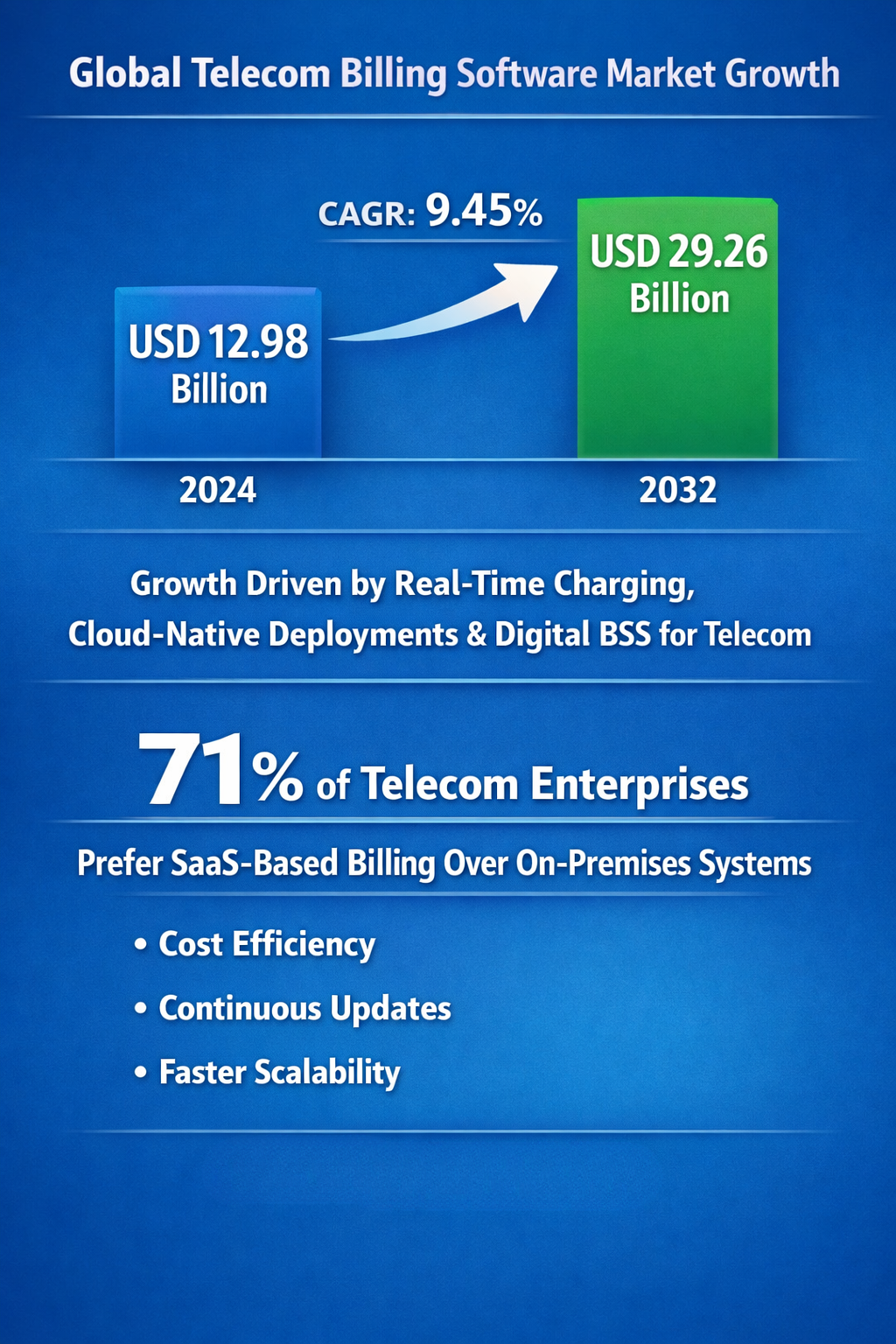
The global telecom billing software market is projected to grow from USD 12.98 billion in 2024 to USD 29.26 billion by 2032, at a CAGR of 9.45%, driven by demand for real-time charging, cloud-native deployments, and digital BSS for telecom. (Source: Introspective Market Research, 2024)
71% of telecom enterprises now prefer SaaS-based billing over on-premises systems, citing cost efficiency, continuous updates, and faster scalability as the primary drivers.
Strategy 1: Unify Billing Across All Services with Convergent Charging
Running separate billing stacks for voice, data, SMS, and digital content creates revenue leakage, operational overhead, and a fragmented customer experience. Convergent charging consolidates all services onto a single, real-time platform and is the cornerstone of any serious telecom billing system modernization.
Modern telecom billing systems must handle multi-service, multi-play environments, from OTT bundles to IoT plans. Convergent charging allows operators to manage prepaid, postpaid, and hybrid subscribers through a single unified engine, enabling real-time balance management, shared data buckets, and dynamic promotions across all touchpoints. This is foundational to any credible BSS solution.
Strategy 2: Deploy Real-Time Billing to Eliminate Revenue Leakage
Batch-based telecom billing software processes usage data in intervals, often hours after the event, leaving a dangerous window for unbilled usage, fraud, and inaccurate invoices. Real-time online charging systems (OCS) close that window entirely. Each transaction is validated, rated, and instantly debited or credited, giving both the operator and the subscriber an accurate view of spending in the moment.
This is especially critical for telecom billing software for subscription management in markets where prepaid dominates. In regions such as Sub-Saharan Africa, where over 80% of subscribers are prepaid, real-time balance management is the core business requirement. Approximately 41% of telecom companies cite revenue leakage as a key operational risk, underscoring why real-time capabilities in telecom billing systems are non-negotiable.
For postpaid and enterprise segments, real-time billing enables spend alerts, credit limit controls, and immediate service modifications, all of which reduce disputed invoices and improve collections efficiency. Operators that have migrated from batch to real-time telecom billing systems consistently report double-digit improvements in revenue assurance KPIs within the first year.
Strategy 3: Leverage Digital BSS for Faster Time-to-Market
The ability to launch a new product in hours, not months, defines whether a CSP can compete in 2026. Traditional billing platforms built on rigid monolithic architectures require lengthy development cycles for even minor plan changes. Digital BSS for telecom, built on microservices, cloud-native architectures, and open APIs, flips this dynamic on its head.
With a digital BSS for telecom platform, product managers can configure new offer templates, bundle rules, tiered pricing, and promotional logic through low-code catalogue tools, bypassing lengthy IT queues. This agility allows operators to respond to competitor moves within the same business day, rather than waiting for the next software release cycle.
6D Technologies’ Digital BSS platform is purpose-built for speed-to-market. Watch the product glimpse to see how operators configure and launch plans in real time with zero downtime and no hardcoding required.
Strategy 4: Adopt Cloud-Native Telecom Billing for Scalability and Resilience
The migration from on-premises telecom billing software to cloud-native architectures is accelerating across every market segment. As confirmed by market data, 71% of telecom enterprises already prefer SaaS-based billing deployments. The reasoning is clear: cloud-native billing scales dynamically with traffic spikes. Such as during national holidays, major sporting events, or 5G network launches, without requiring pre-provisioned hardware.
Beyond cost efficiency, cloud-based telecom billing systems offer continuous delivery of software updates, built-in redundancy, disaster recovery, and geo-distributed deployments for operators with multi-country footprints.
There is no longer a need to manage:
- Patching windows
- Hardware refresh cycles or
- Capacity forecasting for peak events
All of that becomes the responsibility of the platform provider.
For telecom billing software companies operating in emerging markets, cloud-native deployment also removes the barrier of significant upfront capital expenditure. Operators can onboard a world-class Digital BSS solution on an operational-expenditure model, thereby improving the financial case for modernization.
Strategy 5: Embed AI and Analytics Into Your BSS Solution
The next generation of digital BSS solution platforms is AI-infused. Operators are embedding machine learning into their telecom billing software to detect anomalies, predict churn, personalize offers, and prevent fraud before it materializes. AI-driven analytics in billing systems are now being adopted by 45% of telecom operators globally, and the early movers are establishing a significant competitive advantage.
Beyond fraud prevention, AI enables dynamic pricing, automatically adjusting offer eligibility based on subscriber behavior, network conditions, and competitive intelligence, all in real time. Predictive churn models embedded in the BSS solution can automatically trigger retention offers when a subscriber’s behavioral patterns indicate elevated flight risk, reducing the cost of retention campaigns while improving their effectiveness.
Strategy 6: Build Robust Telecom Billing Software for Subscription Management
The subscription economy is reshaping how telecom operators monetize their services. From Netflix bundles to cloud storage add-ons, gaming passes, and IoT connectivity plans, modern subscribers expect flexible, self-service subscription experiences. Your telecom billing software for subscription management must be sophisticated enough to handle auto-renewals, grace periods, upgrades, downgrades, pauses, and multi-tier bundles, all with zero manual intervention.
Crucially, the subscription management layer must feed seamlessly into your invoicing, collections, and customer self-care portals. A disjointed experience between what a subscriber signs up for and what appears on their invoice is the fastest way to erode trust and drive churn. Poorly managed subscription billing is cited as a primary reason for involuntary churn in up to 30% of cases across digital service providers.
Investing in purpose-built telecom billing software for subscription management is a direct investment in customer lifetime value. Operators with advanced subscription engines consistently outperform peers in net promoter score, average revenue per user, and subscriber retention.
Strategy 7: Modernize Legacy Billing Systems with a Phased Migration Approach
One of the most common barriers to modernization among operators partnering with telecom billing software companies is the fear of “big bang” migrations, replacing legacy telecom billing systems in a single, high-risk cutover. The smart strategy is phased migration: incrementally decoupling and replacing components of the legacy stack while keeping core revenue systems fully operational throughout the transition.
A proven approach is to use a digital BSS for the telecom layer as an orchestration fabric. New services, such as 5G plans, eSIM activations, or IoT tariffs, are launched on the modern platform first, while legacy services continue to run undisturbed. Over time, subscriber migration is managed in carefully planned batches, typically beginning with new activations before progressively migrating the existing installed base.
This strategy significantly reduces risk, allows IT and commercial teams to build confidence in the new digital BSS solution through real operational experience, and delivers measurable ROI from the first wave of migration, without waiting for a full system replacement. It also creates space for organizational change management: training, process redesign, and integration testing can happen progressively rather than in a compressed, high-stress cutover window.
Strategy 8: Integrate Partner and Wholesale Billing to Unlock New Revenue Streams
As telecom operators evolve from connectivity providers into digital service marketplaces, their telecom billing systems must be capable of managing complex, multi-party revenue flows. This includes revenue sharing with content partners, wholesale interconnect billing, MVNO billing, roaming settlement, and B2B enterprise billing, all of which require a degree of precision and automation that basic billing platforms simply cannot provide.
Without efficient telecom billing software in your BSS solution, operators are forced to manage these revenue flows using manual spreadsheets and offline reconciliation, leading to delays, disputes, and inevitable revenue leakage at the ecosystem level.
Strategy 9: Prioritize Self-Care and Transparent Billing UX
The final, and arguably most customer-facing strategy, is ensuring that your telecom billing software powers a compelling, transparent self-care experience. Research confirms that 62% of consumers prefer service providers that offer transparent billing and real-time usage insights. This means your telecom billing software must expose clear, near-real-time usage data through web portals, mobile apps, and USSD menus, not just on the monthly invoice.
Effective self-care reduces inbound call center volumes, which represent a high operational cost for most CSPs, and creates natural upsell opportunities. A subscriber who can see in real time that they have used 90% of their data allowance is far more likely to purchase a top-up or upgrade their plan directly through the self-care app than to call customer support and potentially become frustrated.
This is where digital BSS for telecom platforms truly differentiates itself. They enable real-time billing and usage APIs to omnichannel self-care interfaces that serve the modern, mobile-first subscriber seamlessly, whether in a metro city or a rural market with only feature phone access.
Conclusion:
The advancement of telecom billing software from a back-office function to a strategic revenue enabler is well underway. As global spending on telecom billing and revenue management continues its strong upward trajectory, the gap between operators running modern telecom billing systems and those still relying on legacy stacks will only widen in customer experience, revenue performance, fraud resilience, and competitive agility.
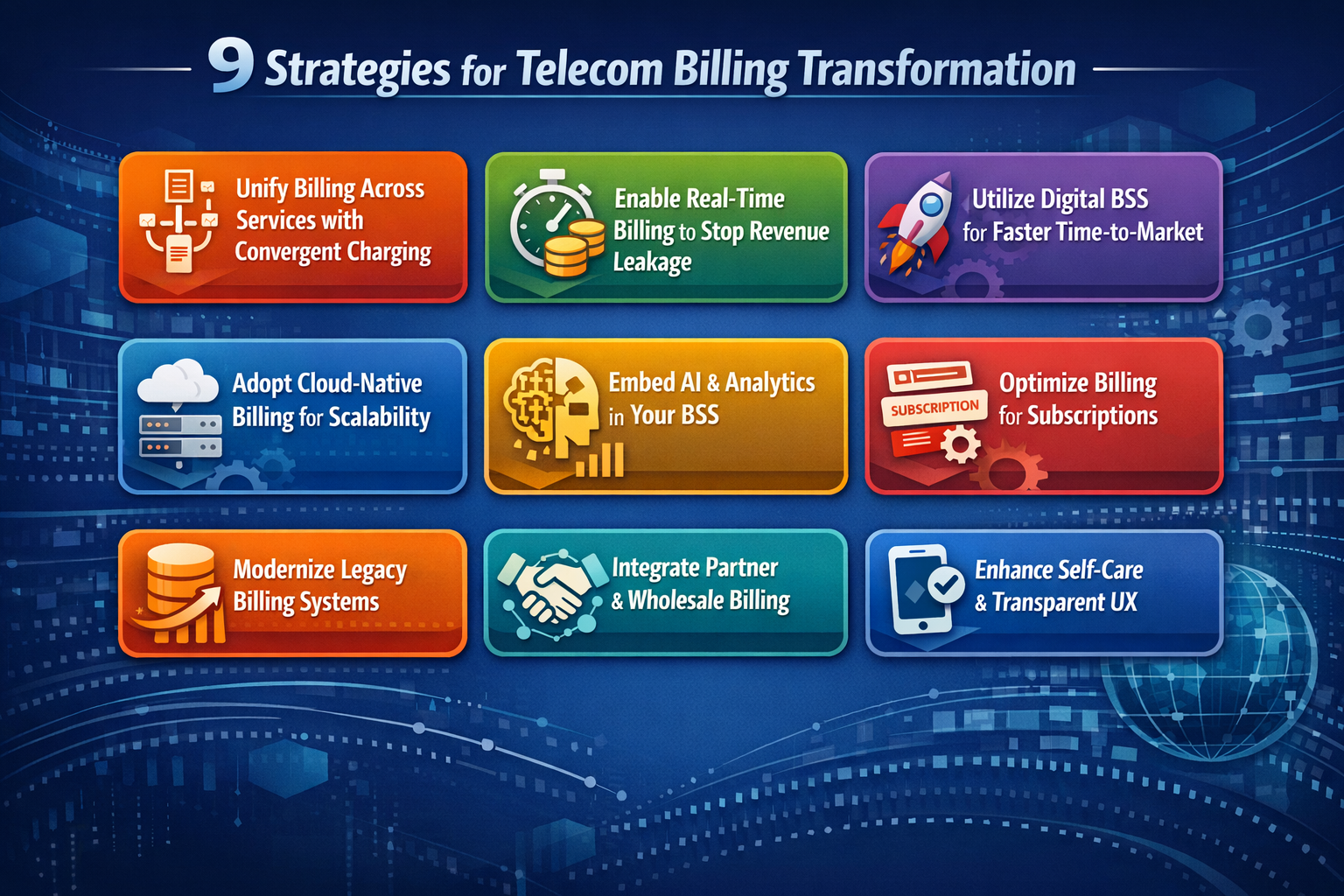
The 9 strategies outlined in this blog are not theoretical roadmaps. They represent the lived experience of operators who have already made the transformation journey. Many of the 6D Technologies clients have emerged with stronger revenue engines, lower churn, and the ability to launch new services at digital speed with their modern digital BSS platforms.
In short, the operators who will win in the 5G era are those who treat telecom billing software not as a cost center to be minimized, but as a revenue platform to be invested in. A modern BSS solution that combines real-time charging, AI-driven analytics, cloud-native scalability, robust subscription management, and frictionless self-care is not just good IT infrastructure. Still, a genuine competitive weapon in a market where margins are under constant pressure and subscriber expectations are rising relentlessly.
Key Takeaways from This Blog:
- Convergent charging eliminates revenue leakage by unifying all services, voice, data, content, and IoT on a single real-time billing engine
- Real-time telecom billing systems close the fraud and leakage window that batch processing inevitably leaves open
- Digital BSS for telecom compresses time-to-market from months to hours, giving CSPs the agility to compete in fast-moving markets
- Cloud-native telecom billing software delivers the scalability, resilience, and cost efficiency that modern operators require
- AI and machine learning embedded in your digital BSS solution dramatically reduce fraud and enable hyper-personalized monetization strategies
- Subscription management capabilities are central to any recurring revenue and digital services strategy
- Phased migration from legacy telecom billing systems minimizes risk while delivering measurable ROI from the earliest stages
- Partner and wholesale billing integration enables new digital revenue streams well beyond traditional connectivity
- Transparent, real-time billing UX through self-care portals directly reduces churn and boosts upsell conversion rates
- 6D Technologies is the proven, globally trusted partner for CSPs seeking best-in-class telecom billing software, digital BSS solutions, and end-to-end revenue management transformation.
Choosing the right telecom billing software partner can define the trajectory of your business for the next decade. In an industry where revenue complexity is increasing, subscriber expectations are evolving, and the window for 5G monetization is opening, there is no room for billing platforms that cannot keep pace.
6D Technologies is the leading provider of convergent billing, digital BSS for telecom, and revenue management solutions purpose-built for the world’s growth markets, with a track record of delivering measurable, real-world results for Tier-1 and Tier-2 operators. From real-time OCS and subscription management to AI-powered fraud detection and cloud-native BSS, 6D Technologies brings the full stack of capabilities that modern CSPs demand.
Whether you are modernizing legacy telecom billing systems, launching a digital-first MVNO, building an OTT content marketplace, or scaling your BSS solution to support 5G and IoT, 6D Technologies has the platform, the people, and the partnership model to make it happen, on time and on budget.
Contact us today to speak with a billing transformation specialist, or visit the 6D Technologies website to explore the product portfolio, client case studies, and the latest thinking on digital BSS and telecom billing innovation.
Frequently Asked Questions
Q: What is telecom billing software, and why is it important for CSPs?
Telecom billing software is a specialized platform that manages the end-to-end process of rating, charging, invoicing, and revenue collection for communication service providers.
It is mission-critical because it directly impacts revenue accuracy, subscriber experience, fraud prevention, and the operator’s ability to launch new services at speed. Without a robust telecom billing system, CSPs face revenue leakage, regulatory non-compliance, and an inability to support modern service models such as 5G network slicing, IoT connectivity, and subscription bundles. In an industry where margins are under constant pressure, billing software is one of the highest-leverage investments an operator can make.
Q: How does telecom billing software for subscription management work?
Telecom billing software for subscription management automates the complete lifecycle of recurring services from initial activation and plan selection through renewals, upgrades, downgrades, add-ons, grace periods, and eventual cancellation. It integrates with the operator’s product catalogue, payment gateway, CRM, and self-care portal to ensure that every subscriber interaction is accurately reflected in real-time billing records. Advanced platforms support multi-tier bundles, shared family plans, partner content subscriptions, and cross-service promotions within a single unified engine, eliminating the manual processes and reconciliation delays that drive both operational cost and subscriber dissatisfaction.
Q: What is the difference between a BSS solution and a traditional billing system?
A traditional billing system primarily handles rating, invoicing, and payment collection as a back-office function. A modern BSS (Business Support System) solution is a far broader platform that encompasses billing, customer management, product cataloguing, order management, revenue assurance, partner management, and analytics, all in an integrated, typically cloud-native architecture. Digital BSS for telecom is specifically designed to support the speed and complexity of digital service monetization, whereas traditional systems were built for simpler, voice-centric environments. The shift from a legacy billing system to a full BSS solution is fundamentally a shift from reactive cost management to proactive revenue optimization.
Q: How do I choose the best telecom billing software company for my operator?
When evaluating telecom billing software companies, consider these key criteria:
- Proven deployments at comparable operators in terms of scale and market type;
- support for real-time convergent charging across all service types;
- cloud-native architecture with microservices and open API standards;
- Integrated AI and analytics for fraud detection and revenue optimization;
- Flexibility in deployment model (SaaS, private cloud, or on-premise);
- And a strong post-deployment support and managed services capability.
6D Technologies consistently delivers across all of these dimensions, with deep regional expertise in the markets where billing complexity is highest.
Q: What are the key benefits of digital BSS for telecom operators in the 5G era?
Digital BSS for telecom in the 5G era delivers several transformative benefits: dramatically faster time-to-market for new services (from months to hours), real-time charging and policy control for 5G network slicing, seamless support for IoT device billing at massive scale, AI-powered revenue assurance and fraud management, cloud-native scalability to handle 5G traffic volumes, and API-driven integration with third-party digital ecosystem partners. Operators that modernize to digital BSS are far better positioned to monetize 5G differentiated services, such as guaranteed ultra-low-latency connectivity for enterprise customers, rather than commoditizing 5G as plain data bandwidth.
Q: How long does it typically take to migrate from legacy telecom billing systems to a modern platform?
Migration timelines vary based on the complexity of the legacy environment, the number of active subscribers, and the breadth of services being migrated. A typical phased migration with a partner like 6D Technologies delivers an initial go-live of new services on the modern telecom billing software within 3–6 months, with full migration of the existing subscriber base completed over 12–24 months. The phased approach ensures revenue continuity throughout the transition, minimizing business risk while enabling the operator to begin realizing the benefits of modern telecom billing systems from the earliest stages, without waiting for a full cutover that could potentially disrupt millions of live subscribers.