
By a VP, 6D Technologies
I have seen telecom modernization programmes lose momentum for a predictable reason: operators approach transformation as a replacement exercise rather than an architectural decision.
The assumption is that legacy systems must disappear before innovation can begin. But replacing an entire BSS environment introduces migration risks, operational disruption, significant investment, and years of implementation complexity.
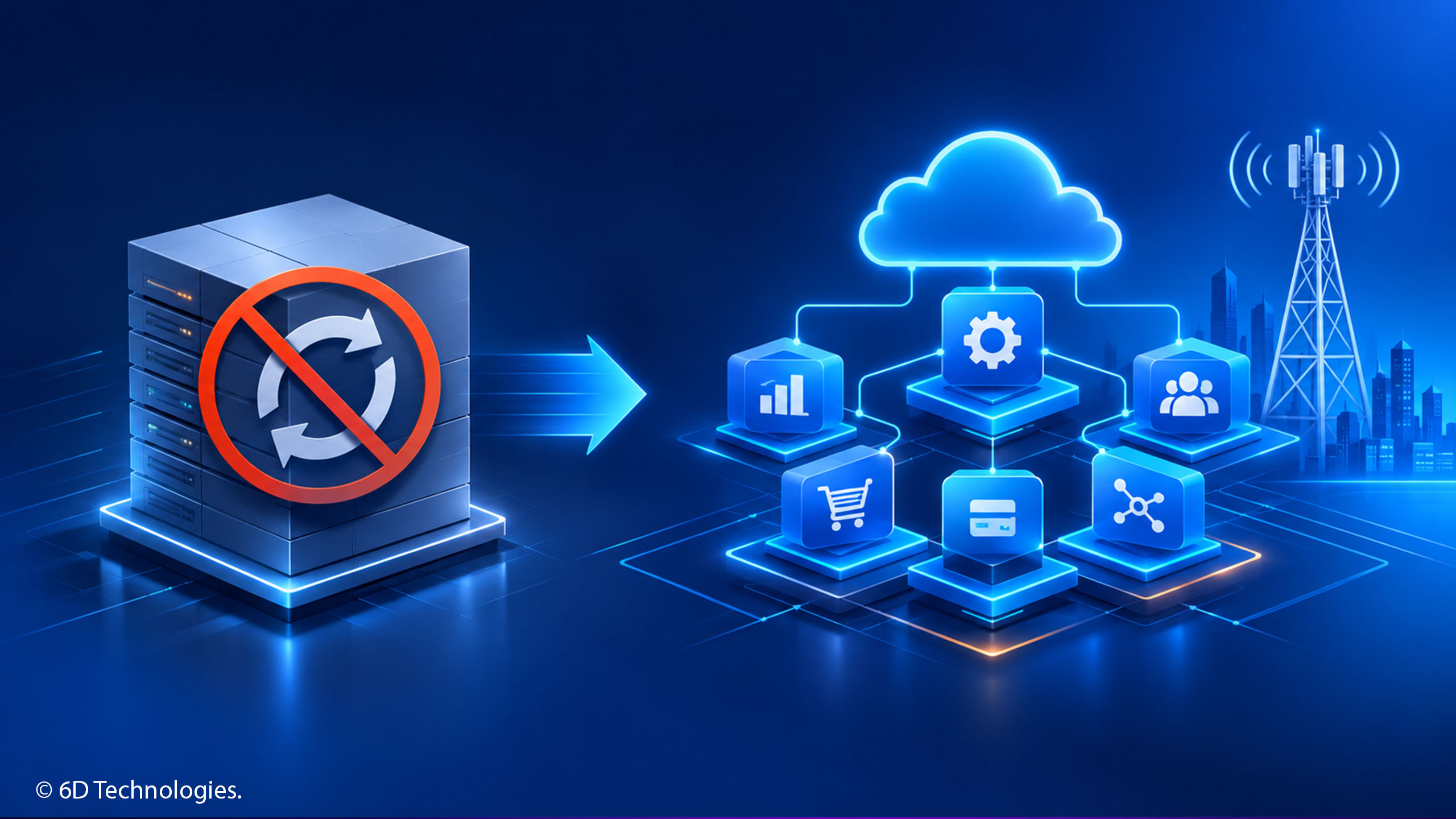
I believe operators should ask a different question: Why replace everything when the architecture itself can evolve?
The future of telecom depends on composability. A modern cloud BSS solution environment should allow operators to modernize individual capabilities, connect new technologies, and evolve business processes without repeatedly rebuilding the entire foundation.
The Problem With the Rip-and-Replace Mindset
Telecom infrastructure has accumulated over decades. Billing, customer management, product catalogues, partner settlements, and service provisioning often operate across different platforms.
Replacing everything simultaneously might appear attractive from an architectural standpoint. In reality, it creates substantial business risk.
Customer records must migrate accurately. Revenue processes must remain uninterrupted. Integrations must continue functioning. Existing services cannot simply stop while new systems are implemented.
This is why modernization projects frequently become longer and more expensive than initially anticipated.
A cloud BSS strategy should not require operators to discard functioning capabilities simply because other components need modernization.
The objective should be to identify architectural dependencies, separate tightly coupled functions, and introduce modern capabilities where they deliver the greatest value.
Composability Changes the Modernization Conversation with Cloud BSS Solution
Composable architecture changes how operators think about their technology investments.
Instead of treating BSS as one indivisible application, organizations can structure their environments around independent business capabilities connected through standardized interfaces.
A digital BSS solution built around this philosophy can support incremental transformation.
For example, an operator might modernize customer engagement first, introduce a new charging capability later, and subsequently upgrade partner management without replacing every underlying application.
This approach creates three important advantages:
- Lower transformation risk: Operators can modernize individual capabilities while maintaining existing operations.
- Greater architectural flexibility: Independent components can evolve without forcing changes across the entire ecosystem.
- Faster innovation: New services and business models can be introduced without waiting for complete platform replacement.
This is particularly relevant as cloud BSS solutions become central to telecom modernization strategies.
Decoupling Is More Important Than Simply Moving to the Cloud
There is a distinction the industry needs to recognize.
Moving an existing application to cloud infrastructure does not automatically make it composable.
A tightly coupled application remains tightly coupled even when hosted in the cloud.
True architectural independence requires separation of business capabilities, well-defined APIs, independent release cycles, and interoperability between systems.
A digital cloud BSS solution must therefore be evaluated on more than deployment infrastructure.
Consider 5G BSS requirements. Operators need flexible charging, real-time service configuration, network monetization, and support for emerging enterprise services.
A rigid platform can make every new capability dependent on extensive modifications to existing components.
A decoupled architecture allows these capabilities to evolve independently while maintaining business continuity.
That is the real value of a cloud BSS solution: not simply infrastructure flexibility, but the ability to change without destabilizing everything around it.
The Business Case for Independent BSS Capabilities
The financial argument for composability is often overlooked.
When systems are tightly coupled, even relatively small changes can require extensive testing, integration work, and coordinated releases.
These dependencies increase maintenance costs and slow down innovation.
A composable telecom BSS solution can reduce this complexity by allowing operators to upgrade specific capabilities instead of repeatedly undertaking large transformation programmes.
Consider three business functions.
Customer management: Modern telecom CRM software should integrate with billing, product catalogues, and engagement platforms without becoming dependent on a single underlying application.
Partner ecosystems: As distribution networks expand, the best partner management software in telecom should support independent onboarding, commission management, settlement, and performance monitoring.
Revenue management: A modern convergent billing system should accommodate multiple services, charging models, and customer relationships without forcing changes across unrelated business functions.
Each capability has different innovation requirements. Treating them as one indivisible system restricts the operator’s ability to respond independently.
The best partner management software in telecom should therefore be evaluated on interoperability and scalability, not merely its administrative features.
5G and Digital Services Demand Greater Flexibility
The arrival of 5G has expanded the commercial possibilities available to operators.
Network slicing, enterprise connectivity, IoT, and differentiated service experiences introduce business models that traditional BSS architectures were not necessarily designed to support.
5G BSS must accommodate increasingly dynamic charging requirements, flexible product configurations, and new partner relationships.
Similarly, digital BSS in telecom must support a wider ecosystem of applications, channels, and service providers.
A cloud BSS solution architecture makes it easier to introduce new capabilities, provided the underlying applications are genuinely decoupled.
This is also important for operators expanding into digital financial services, IoT, and enterprise solutions. Each business line may require different capabilities, but they should not operate as disconnected technology environments.
A well-designed telecom BSS solution should connect these capabilities while preserving their operational independence.
The Architecture Must Support More Than Technology Upgrades
I would argue that composability is ultimately a business strategy.
Telecom operators are competing on how quickly they can introduce products, build partnerships, personalize customer experiences, and monetize new opportunities.
That requires more than a modern billing platform.
It requires a connected architecture where customer management, revenue operations, distribution, analytics, and service delivery work together.
The best partner management software in telecom should connect distribution ecosystems with broader commercial operations. Telecom CRM software should provide consistent customer intelligence across channels. A convergent billing system should support changing commercial models.
These capabilities become significantly more valuable when they can evolve independently.
At 6D Technologies, our approach reflects this architectural direction through a connected ecosystem of platforms, including Canvas, Magik, Ventas, Lynx, Infinity, and Aureus.
Rather than viewing every business capability as part of one rigid application, this ecosystem supports different operational requirements across the telecom value chain.
The objective is to give operators flexibility without sacrificing integration or business continuity.
AARYA Adds Another Dimension to Composable BSS
Architecture is also changing because AI is becoming part of everyday telecom operations.
Through AARYA, our embedded AI engine, 6D Technologies is advancing an approach in which intelligence works closer to the business processes it supports.
This becomes particularly relevant in composable environments.
AI should be able to use relevant business context, generate insights, and support decisions across connected platforms without creating another isolated technology layer.
Whether the requirement involves customer value management, operational automation, or business intelligence, the underlying architecture must allow intelligence to work across capabilities.
This is where digital cloud BSS solutions in telecom move beyond system modernization toward intelligent business orchestration.
The Question Operators Should Be Asking
I do not believe the next generation of telecom platforms will be defined by how many legacy systems they replace.
They will be defined by how effectively they allow operators to change.
A cloud BSS solution environment should support continuous modernization. A digital BSS solution should accommodate new business requirements without unnecessary architectural dependencies. A telecom BSS solution should make innovation possible without repeatedly disrupting existing operations.
For telecom leaders, the decision is no longer simply whether to replace legacy BSS.
It is whether the architecture can support the next decade of business change.
At 6D Technologies, we believe the answer lies in composability, decoupled capabilities, and embedded intelligence.
The future of BSS is not about replacing everything that exists. It is about building an architecture where nothing has to hold everything else back. To learn more about our AI-driven, cloud BSS solution, get in touch with us.
Author: Nipun Marhatha (Associate Vice President)