

6D Technologies has spent years establishing itself as the industry leader in telecom software, and nowhere is that leadership clearer than in telecom inventory management. As operators scale 5G, fiber, and IoT rollouts in 2026, disconnected systems create blind spots that quietly drain revenue and slow service delivery. Inventory management in telecom is no longer a back-office task; it is the operational backbone that decides whether a telco can compete. This blog explores why inventory management in telecom matters more than ever, where blind spots hide, and how 6D Technologies helps operators eliminate them for good.
Why Operational Blind Spots Are Growing in 2026
Telecom networks have never been more complex. Between physical assets like routers, base stations, and SIM inventories, and logical assets like bandwidth allocations, service bundles, and license agreements, operators are managing more moving parts than ever before. Without a unified approach to inventory management in telecom, these moving parts drift out of sync, and that drift is exactly where blind spots form.
A blind spot, in this context, is any gap between what a system of record says exists and what is actually deployed, available, or billable. When telecom inventory management is fragmented across spreadsheets, legacy databases, and siloed regional systems, teams lose visibility into stock levels, asset locations, and service availability. The result is delayed provisioning, inaccurate billing, duplicate orders, and frustrated field teams who show up to a site only to find the wrong equipment or no equipment at all.
This is precisely the gap that inventory management in telecom is designed to close. By centralizing every physical and logical asset into a single source of truth, telecom inventory management gives operators the real-time visibility they need to plan, sell, deploy, and bill accurately, every single time.
The Real Cost of Poor Inventory Visibility
Operators without mature inventory management in telecom pay for it in ways that are not always obvious on a balance sheet. Field technicians waste hours locating equipment. Sales teams quote services that cannot actually be fulfilled. Finance teams reconcile invoices against assets that no longer exist. Every one of these problems traces back to the same root cause: a lack of accurate, centralized telecom inventory management.
Independent research backs this up. According to an analysis published by GeakMinds, organizations that implement optimized inventory systems report reductions in holding costs of 20-30%, underscoring how much capital sits idle when telecom inventory management is left unmanaged. Separately, industry research on telecom retail management systems found that more than half of telecom operators 57% reported improved operational efficiency after adopting advanced retail management tools, confirming that the return on investment for modern inventory management in telecom is measurable and significant.
These numbers matter because they translate directly into competitive advantage. Every percentage point of holding cost recovered, and every gain in operational efficiency, funds the next network upgrade, the next customer acquisition campaign, or the next market expansion.
Where Blind Spots Typically Hide
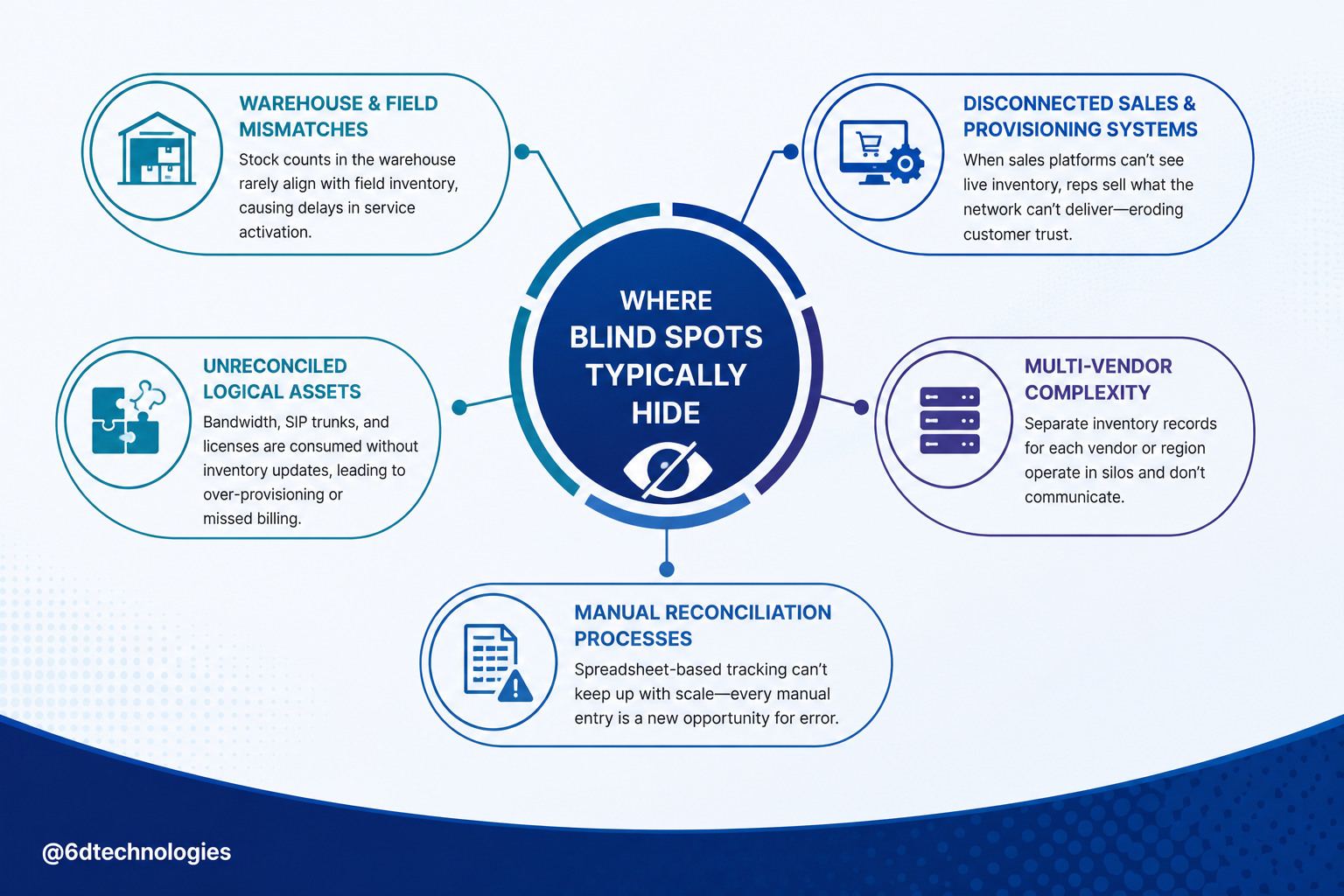
Understanding where blind spots originate is the first step toward eliminating them through disciplined inventory management in telecom. The most common sources include:
- Warehouse and field inventory mismatches: Stock counts in the warehouse rarely align with what field technicians have on hand, causing delays in service activation.
- Disconnected sales and provisioning systems: When a telecom sales and distribution platform cannot see live inventory, reps sell products the network cannot deliver, eroding customer trust.
- Unreconciled logical assets: Bandwidth, SIP trunks, and license agreements are consumed without corresponding updates to the inventory system, leading to over-provisioning or missed billing.
- Multi-vendor complexity: Operators working with multiple equipment vendors and regional partners often maintain separate inventory records for each vendor, none of which communicate with one another.
- Manual reconciliation processes: Spreadsheet-based tracking simply cannot keep pace with the scale of a modern telecom operation, and every manual entry is a new opportunity for error.
Each of these gaps compounds the others. A warehouse mismatch delays a field job, which delays activation, which delays billing, which eventually shows up as a discrepancy in the finance team’s books. Eliminating operational blind spots means addressing the entire chain, not just one link.
How Telecom Inventory Management Software Closes the Gap
Modern telecom inventory management software gives operators a real-time, end-to-end view of every asset across the network, from the core to the customer premises. Instead of reconciling numbers after the fact, teams work from a single, continuously updated source of truth. This is the foundation of effective inventory management in telecom in 2026.
The core capabilities that separate a leading platform from a basic tracking tool include:
- Real-time asset visibility across warehouses, field teams, and regional depots
- Automated reconciliation between physical stock and logical service records
- Integration with order management, billing, and CRM systems
- Predictive restocking based on demand forecasting and historical consumption
- Role-based access so sales, finance, and operations teams see the same accurate data
When inventory management in telecom is properly integrated, sales teams can confidently promise what the network can deliver, field teams arrive with the right equipment, and finance teams close the books without chasing down discrepancies. This is what mature inventory management in telecom looks like in practice, and it is the standard 6D Technologies builds toward with every deployment.
The Role of Sales and Distribution Platforms
Inventory management in telecom does not operate in isolation. It is deeply tied to how operators sell, distribute, and finance their services. A well-integrated telecom sales and distribution platform connects directly to inventory data, ensuring that every quote, order, and channel partner transaction reflects what is actually available.
Without this connection, sales and distribution operations become a guessing game. Channel partners oversell nonexistent inventory, and distributors carry excess stock in one region. In contrast, another region runs short, and finance teams struggle to reconcile revenue against actual asset movement. A modern telecom sales and distribution platform eliminates this disconnect by tying every transaction back to live inventory data, giving operators a single, trustworthy view of stock, sales, and fulfillment.
This is also where a sales and distribution solution for finance becomes essential. Telecom operators need more than basic stock tracking; they need a sales and distribution finance solution that directly links inventory movement to revenue recognition, invoicing, and financial reporting. When a sales and distribution solution for finance is integrated with telecom inventory management, finance teams can trace every rupee of revenue back to a specific asset, transaction, and channel partner, closing the loop between operations and the balance sheet.
6D Technologies has built exactly this kind of integration into its platform, ensuring that a sales and distribution solution for finance is not a bolt-on afterthought but a core part of how telecom inventory management functions end-to-end.
Why 2026 Is a Turning Point
Several forces are converging in 2026 to make inventory management in telecom a board-level priority rather than a purely operational concern.
First, 5G and fiber densification are multiplying the number of physical assets that operators must track, from small-cell equipment to fiber splice closures. Second, IoT deployments are adding millions of connected devices to telecom networks, each one a line item that must be provisioned, tracked, and billed. Third, customers now expect near-instant service activation, which is only possible when telecom inventory management software can confirm availability in real time. Fourth, regulatory and financial reporting requirements are tightening, making accurate, auditable inventory records a compliance necessity rather than a nice-to-have.
Operators that continue to rely on fragmented spreadsheets and siloed systems in this environment will fall behind competitors that have already modernized their telecom inventory management. The operators who invest now in unified telecom inventory management software, connected sales and distribution platforms, and a proper sales and distribution solution for finance will be the ones who can scale profitably through 2026 and beyond.
There is also a financial dimension that many operators underestimate. As telecom services bundle hardware, connectivity, and digital financial products together, finance teams need a sales and distribution solution for finance that can keep pace with increasingly complex revenue streams. Without it, reconciling commissions, partner payouts, and installment-based device financing becomes a manual, error-prone exercise that slows month-end close and increases audit risk. A properly implemented sales and distribution solution for finance removes that friction by tying every sale back to a specific asset and revenue rule from the moment telecom’s inventory management records the transaction.
How 6D Technologies Delivers Complete Visibility
6D Technologies has positioned itself as the industry leader by building inventory management into telecom solutions that unify physical assets, logical services, sales channels, and financial reporting into a single platform. Rather than treating inventory as a standalone module, 6D Technologies designs telecom inventory management as the connective layer that ties together BSS, VAS, IoT, field force management, and digital financial services.
This approach means that operators using 6D Technologies do not just get a tracking tool; they get a complete inventory management in telecom suite that integrates with every other system in the stack. Field force management teams see live stock data before they leave the depot. Sales teams working on a telecom sales and distribution platform see real inventory before they quote a customer. Finance teams working with a sales and distribution solution for finance see every transaction mapped back to a real, trackable asset. This is the level of integration that eliminates operational blind spots rather than simply reporting on them after the damage is done.
A Practical Roadmap for Eliminating Blind Spots in 2026
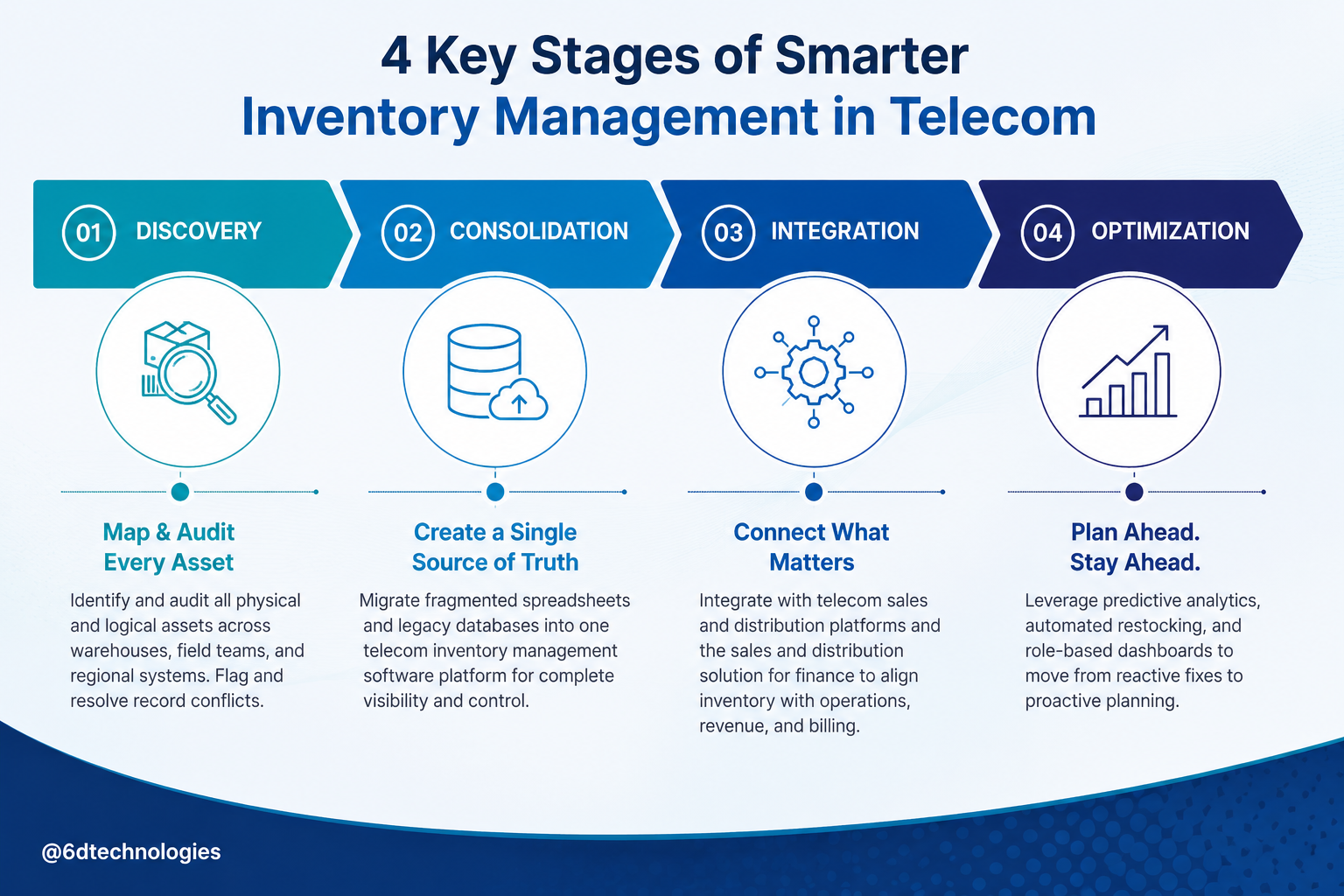
Operators do not need to overhaul every system overnight to see results from better inventory management in telecom. A phased roadmap works best, and it typically follows four stages.
Stage 1. Discovery: Mapping every physical and logical asset currently tracked across warehouses, field teams, and regional systems, and flagging any record conflicts. Most operators are surprised by how many discrepancies surface once inventory management in telecom is audited end-to-end.
Stage 2. Consolidation: Migrating fragmented spreadsheets and legacy databases into a single telecom inventory management software platform that becomes the authoritative source of truth for every asset.
Stage 3. Integration: Connecting that platform to the systems that depend on accurate stock data, particularly the telecom sales and distribution platforms used by direct sales teams and channel partners, as well as the sales and distribution solution for finance that governs revenue recognition and billing. Without this step, even a well-consolidated inventory system stays siloed from the teams that need it most.
Stage 4. Optimization: Layering in predictive analytics, automated restocking, and role-based dashboards to shift inventory management in telecom from reactive reconciliation to proactive planning. At this stage, operators stop asking “what went wrong” and start asking “what should we stock next quarter?”
6D Technologies guides operators through each of these stages, ensuring that telecom sales and distribution platforms, financial reporting, and field operations are never treated as an afterthought to core telecom inventory management. The result is a rollout that delivers measurable gains at every stage rather than a single, risky, all-at-once migration.
Conclusion
A single failure rarely causes operational blind spots in telecom. They build up gradually, from a warehouse count that does not match the field, from a sales quote that outpaces actual stock, from a finance report that cannot trace revenue back to a real asset. Inventory management in telecom aims to close all these gaps at once, replacing fragmented, manual processes with a single, real-time source of truth that sales, operations, and finance teams can all trust. As networks grow more complex through 2026, operators who treat inventory management in telecom as a strategic priority, not an afterthought, will be the ones who scale without losing visibility, revenue, or customer trust.
Key takeaways:
- Operational blind spots form when physical and logical telecom assets are tracked across disconnected, siloed systems
- Poor inventory visibility directly costs operators through delayed provisioning, inaccurate billing, and lost sales opportunities
- Independent research shows optimized inventory systems can reduce holding costs by 20-30%, while advanced retail management adoption has improved operational efficiency for 57% of operators
- A connected telecom sales and distribution platform prevents overselling by tying every quote to real inventory
- A true sales and distribution solution for finance links inventory movement directly to revenue recognition and audit-ready reporting
- 5G densification, IoT growth, and rising customer expectations make 2026 a turning point for telecom inventory management adoption
- 6D Technologies unifies inventory management in telecom, sales and distribution platforms, and financial reporting into one integrated system
Operators that continue running inventory management in telecom on fragmented, manual systems will keep losing revenue to blind spots they cannot even see. The path forward is a single, connected platform that gives sales, operations, and finance teams the same real-time picture of every asset. 6D Technologies stands as the leading provider of inventory management in telecom, sales and distribution platforms, and a true sales and distribution solution for finance, built specifically for the complexity telecom operators face in 2026.
Contact us to know how our telecom inventory management solutions can eliminate your operational blind spots.
FAQs
What is inventory management in telecom?
Inventory management in telecom is the process of tracking, reconciling, and optimizing every physical and logical asset a telecom operator owns or leases, including network hardware, SIM inventory, bandwidth allocations, and service licenses, so that sales, operations, and finance teams always work from accurate, real-time data.
Why do telecom operators need dedicated inventory management software instead of spreadsheets?
Telecom inventory management software automates reconciliation, integrates with billing and CRM systems, and scales with network complexity, something spreadsheets and manual processes cannot do once an operator manages thousands of assets across multiple regions.
How does a telecom sales and distribution platform reduce operational blind spots?
A telecom sales and distribution platform connects directly to live inventory data, so sales reps and channel partners can only quote and sell what the network can actually deliver, preventing overselling and fulfillment delays.
What makes a sales and distribution solution for finance different from standard inventory tracking?
A sales and distribution solution for finance links every inventory movement to revenue recognition and financial reporting, allowing finance teams to trace transactions back to specific assets for accurate, audit-ready books.
How can telecom operators start improving inventory management in telecom in 2026?
Operators should begin by auditing existing systems for fragmentation, then consolidate physical and logical asset tracking into a single telecom inventory management platform that integrates with sales, field operations, and finance.