
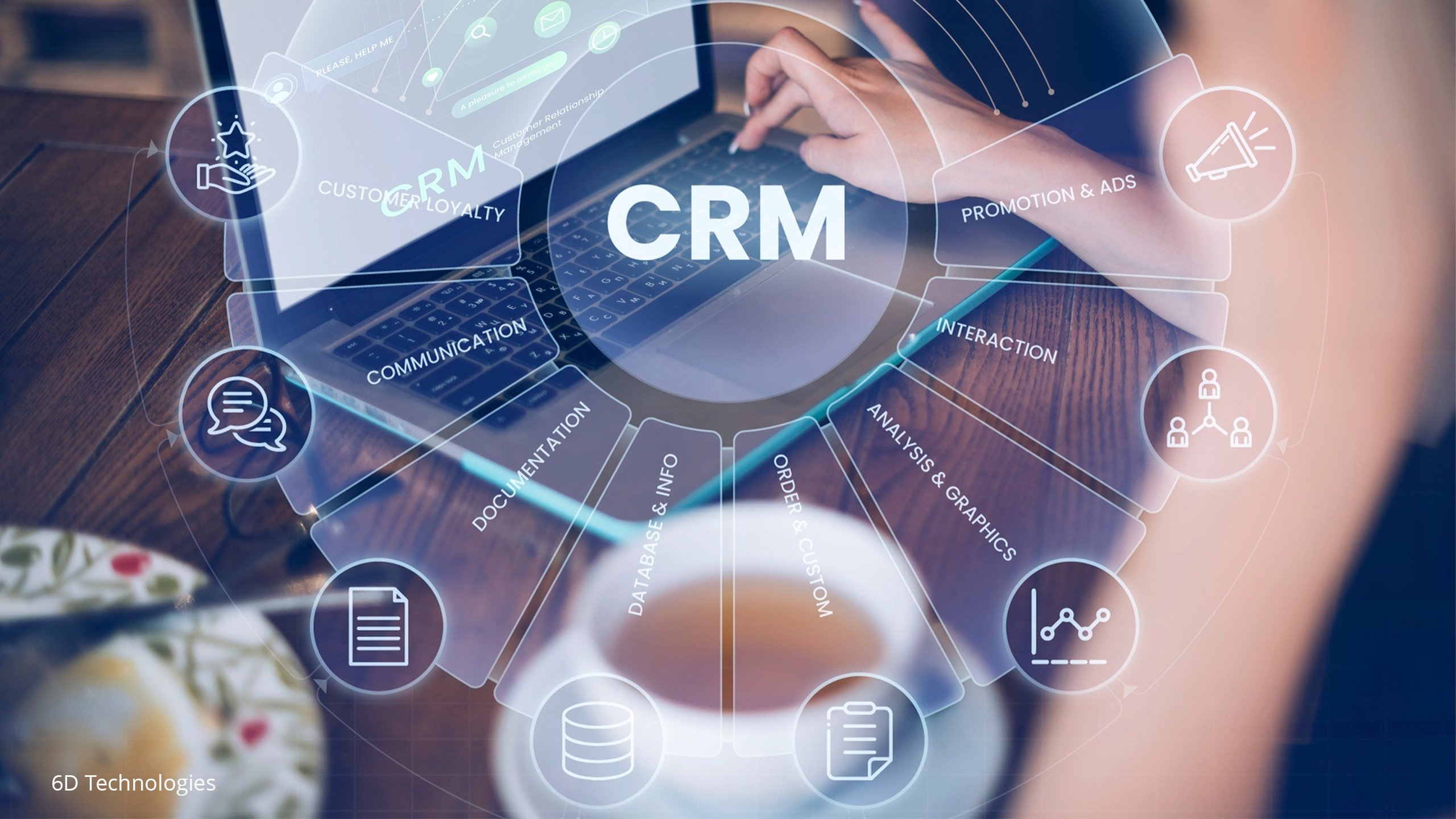
The telecom industry is shifting from simple connectivity to user-friendly digital experiences, and a legacy CRM is not sufficient to survive the 5G era. This blog explores the 7 critical features of a modern Telecom CRM Solution from AI-driven personalization to zero-touch provisioning, and how industry leaders like 6D Technologies are empowering operators to monetize these capabilities effectively with digital BSS.
The New Era of Subscriber Intelligence
We have moved past the era where being a mere connectivity provider was enough to sustain a business. Today, in the age of 5G, IoT, and hyper-connectivity, the battleground is Customer Experience (CX). At the heart of this battle lies the Telecom CRM solution, the central nervous system that dictates how well an operator understands, serves, and retains its subscribers.
However, not all Customer Relationship Management systems are created equal. Legacy platforms, built for a voice-centric world, are struggling to cope with the data velocity and volume of the digital age. Operators clinging to these archaic systems are facing a crisis of relevance. To remain competitive, Communication Service Providers (CSPs) must adopt a next-generation Telecom CRM solution that goes beyond basic contact management. They need a platform that acts as an intelligent engagement engine.
This is where industry leaders have redefined the benchmark. As a pioneer in the Digital BSS space, we have long understood that a CRM is not just a database; it is a revenue generator. By integrating AI-driven analytics with real-time network insights, top telecom CRM platforms enable operators to transition from reactive support to proactive engagement.
According to Fortune Business Insights, the global CRM market is expected to reach a staggering $126.17 billion by 2026, with the telecommunications sector driving a significant portion of this growth through AI integration. This statistic underscores a critical reality: investment in a robust Telecom CRM solution is not an IT expense; it is a strategic imperative for survival.
From Rolodex to Revenue: The Evolution of Telecom CRM
Telecom CRM has evolved with advances in cloud computing and data analytics. What started as a digital phonebook has grown into the brain of the telco operation. Here is how the systems have evolved:
Legacy Era (Pre-2015): The Digital Rolodex
- Focus on storing contact details and basic billing records.
- Siloed data with no connection to network usage.
- Reactive support models (wait for the phone to ring).
Digital Transformation Phase (2016-2023): The Connected System
- Integration with mobile apps and basic self-care.
- Introduction of omnichannel support (Email, SMS).
- Focus on reducing Call Center AHT (Average Handling Time).
Intelligent Era (Present): The AI-Driven Engagement Engine
- Top telecom CRM platforms leads this era with “Digital 360” capabilities.
- Predictive AI anticipates churn before it happens.
- Real-time network data drives marketing offers (Contextual CVM).
- Zero-touch provisioning and autonomous order management.
7 Non-Negotiable Features in Telecom CRM Solution You Can’t Ignore
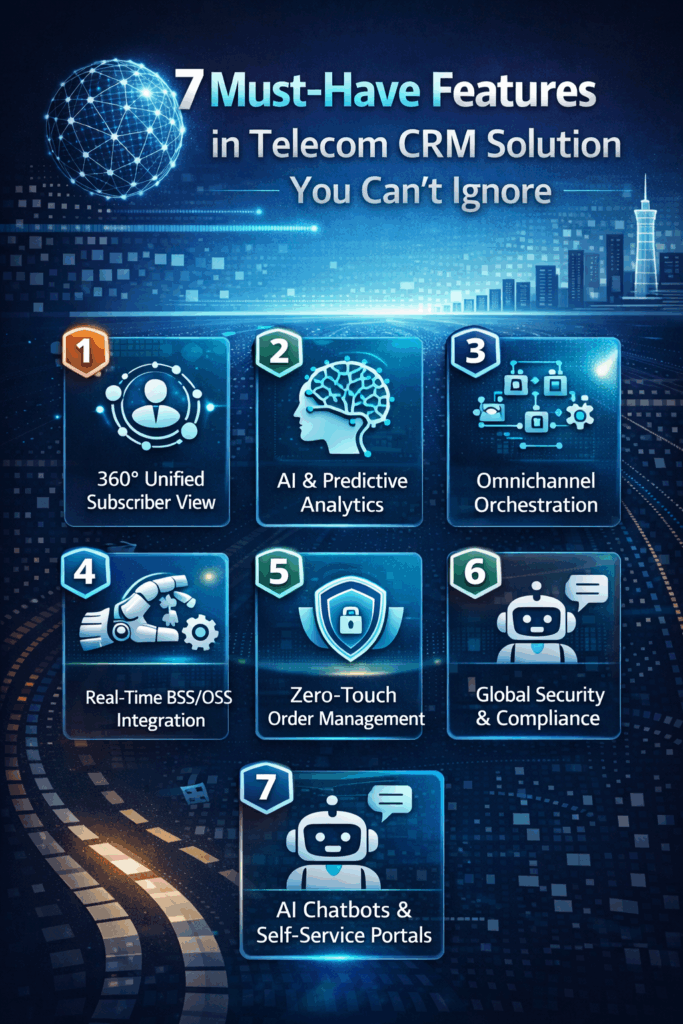
A modern Telecom CRM solution must do more than store data; it must interpret it. Below are the 7 critical features that distinguish a “dumb pipe” utility from a digital powerhouse.
1. Unified 360-Degree Subscriber View (Not Just a Profile)
A standard CRM might show you a customer’s name and address. But does it show you their real-time data usage from the last hour? Does it know they experienced three dropped calls yesterday?
The Concept:
A “Living Profile” that aggregates data from billing, network signaling, and support in real-time.
Tip:
| Operators should look for a telecom CRM solution that updates in milliseconds, not hours. Data silos are the enemy of retention. If the CRM cannot see what the network sees, it is blind. |
Leading solutions, provide a single source of truth. Their Unified Subscriber View bridges the gap between the network core and the front office.
2. AI-Driven Predictive Analytics and Hyper-Personalization
Mass marketing is dead. Sending a generic SMS offer for 1GB of data to a user who has unlimited Wi-Fi at home is ineffective and annoying.
The Concept:
Using Machine Learning (ML) to predict churn before it happens and offer the “Next Best Action”.
Tip:
| Don’t just collect data; use it to trigger automated “anti-churn” workflows. If a high-value customer experiences network failure, the telecom CRM solution should instantly dispatch an apology voucher. |
3. True Omnichannel Orchestration
Customers do not see “channels”; they see a brand. They expect the conversation to pick up exactly where it left off, whether on WhatsApp, the Web, or in a Store.
The Concept:
Preserving the state of interaction across all touchpoints (SMS, USSD, Web, App).
Tip:
| Map the “Identity” across all touchpoints to ensure zero friction. A transaction initiated in a mobile app must be addressed in a physical store without repeating information. |
Statistic:
Data from Market Research Future indicates that organizations with effective omnichannel strategies retain 89% of their customers, compared to only 33% for those with fragmented systems.
Our Unified VAS and Network Solutions ensure the communication layer is perfectly synchronized with the telecom CRM solution, providing a seamless experience across 7+ channels used by modern consumers.
4. Digital BSS/OSS Integration for Real-Time Provisioning
A telecom CRM solution that can’t “talk” to the billing engine or the PCRF in real-time is useless for selling digital services.
The Concept:
Seamless connectivity between the sales layer (CRM) and the technical layer (OSS/BSS).
Tip:
| Prioritize Open API (TM Forum compliant) architectures. This reduces integration timelines from months to weeks and allows for “Plug-and-Play” scalability. |
5. Automated Order Management (Zero-Touch)
We are selling fiber bundles, OTT subscriptions, and IoT devices. Managing this complex product mix manually is impossible.
The Concept:
Automated “Order Decomposition” that breaks down a bundle and provisions it instantly without human help.
Tip:
| Automate the “Lead-to-Cash” cycle. If a customer buys a 5G plan + Netflix, the telecom CRM solution should provision both instantly. |
6. Advanced Security and Global Compliance
In a “Zero Trust” world, handling subscriber data requires military-grade security. The era of trusting everything inside the network perimeter is over.
The Concept:
Modern security goes beyond simple firewalls. It utilizes a Zero Trust Architecture (ZTA), which operates on the principle of “Never Trust, Always Verify.” This means every access request, whether from a field agent in a retail store or a billing admin at HQ, is rigorously authenticated, authorized, and encrypted.
- Granular Role-Based Access Control: Ensuring a support agent can see a customer’s plan but not their credit card number (PII Masking).
- Data Sovereignty vs. Residency: It is not just about where data is stored, but whose laws govern it. A modern telecom CRM solution must be capable of storing German data in Germany and Indonesian data in Indonesia to comply with local regulations such as GDPR, CCPA, and the DPDP Act.
Why It Matters:
The stakes have never been higher. According to the IBM Cost of a Data Breach Report, the average cost of a telecom data breach reached nearly $4.88 million in recent years. Beyond the fines, the loss of subscriber trust is catastrophic. A telecom CRM solution that leaks data is a CRM that destroys brand equity.
Tip:
|
- Local Compliance: Unlike rigid SaaS giants that force data into public clouds abroad, our telecom CRM solutions can be deployed on-premise or in local private clouds, ensuring 100% compliance with national data sovereignty laws.
- Military-Grade Protection: Their Digital BSS suite is built with banking-grade encryption and advanced consent management modules, enabling operators to scale globally without regulatory compliance risk.
7. Self-Service Empowerment via AI Chatbots & Portals
The modern customer demands self-service. In the 5G era, a “call for support” is often viewed as a failure of the digital journey.
The Concept:
Self-service is no longer just an FAQ page. It is a comprehensive digital ecosystem that allows subscribers to manage their entire lifecycle from SIM activation (eKYC) to plan upgrades and technical troubleshooting without human intervention.
- Zero-Touch Provisioning: When a user clicks “Upgrade to 5G” in the app, the telecom CRM solution should immediately trigger network provisioning (HLR/HSS updates) and update the billing engine (OCS) within seconds.
- Conversational AI (GenAI-powered): Moving beyond rigid “Press 1 for Billing” menus to natural language bots that can interpret intent (e.g., “Why is my bill higher this month?”) and provide contextual explanations.
The Business Impact:
According to Simon-Kucher’s Global Telecommunications Study 2025, 81% of subscribers now use their provider’s mobile app as a primary touchpoint. More importantly, customers who engage with digital self-service have a 19% higher Customer Lifetime Value (CLTV) than those who rely on traditional support. By shifting 60-70% of routine queries to bots, operators can reduce their cost-per-interaction from dollars to mere cents.
Tip:
|
Top industry leaders redefine self-service through its Digital Self-Care and “Couch-to-Corridor” journeys.
- 360-Degree Control: The top telecom CRM platforms portals give users absolute control over their data limits, family plans, and Value-Added Services (VAS), significantly reducing the load on physical contact centers.
- AARYA AI Integration: By embedding the AARYA AI engine, we turns a standard chatbot into a proactive advisor. It doesn’t just answer questions; it predicts them, alerting users if they are about to exceed their data limit and offering a one-tap “top-up” before the service slows.
- Proven Results: Operators using the best telecom CRM solutions self-care modules have reported up to a 40% reduction in OPEX related to customer support, while simultaneously seeing a boost in Net Promoter Scores (NPS).
The Real Business Impact: Proven Success Stories
Investing in a Telecom CRM solution is about measurable business outcomes. The following real-world case studies demonstrate how the right modules translate into revenue:
- The Challenge: M1 needed to migrate legacy Prepaid and Postpaid subscribers to a modern stack to improve agility.
- The Solution: They deployed Canvas, a cloud-native Digital BSS platform.
- The Impact: The migration enabled a complete digital transformation of subscriber journeys, significantly reducing time-to-market for new plans and enhancing operational efficiency across the board. This showcases the power of a unified CRM and BSS layer.
- The Challenge: The operator sought to capture the Gen-Z market with a purely digital sub-brand but was constrained by legacy IT.
- The Solution: Using Digital BSS suite, they launched a “digital attacker” brand in just weeks.
- The Impact: The brand acquired 1.8 million subscribers within 8 months, achieving 100% subscriber growth by offering flexible, transparent, and app-based customer experiences that legacy systems could not support.
Your Step-by-Step CRM Modernization Roadmap
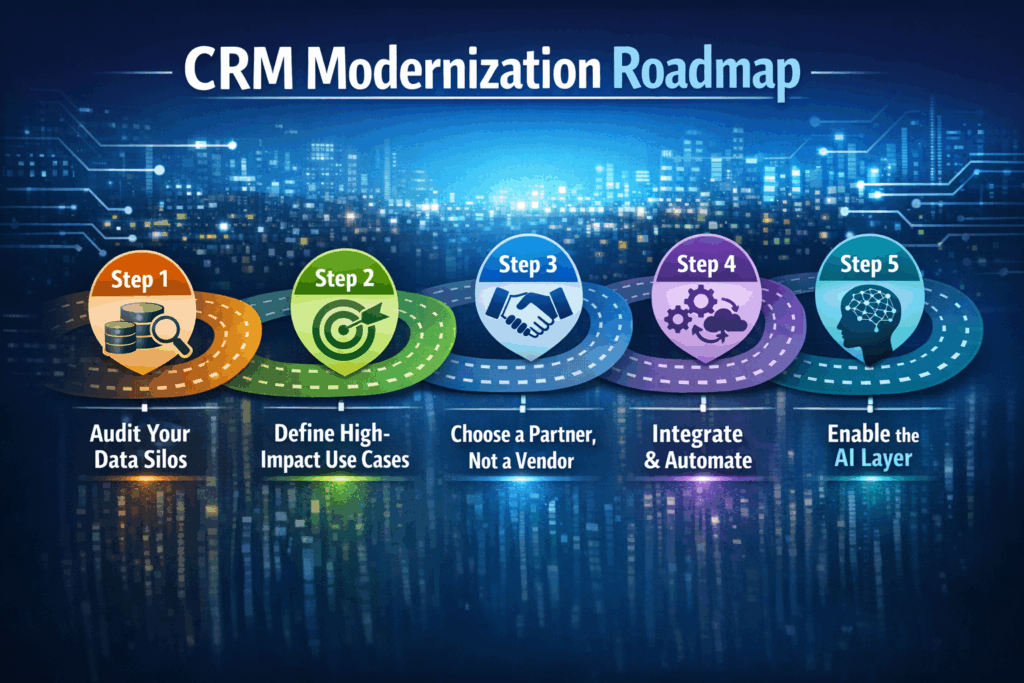
Adopting a new Telecom CRM solution works best when approached as a phased journey. The goal is to build impact first, then scale.
Step 1. Audit Your Data Silos
Identify where your customer data currently lives. Is it trapped in the billing system? Is it on spreadsheets?
Step 2. Define High-Impact Use Cases
Don’t try to fix everything at once. Focus on “Churn Reduction” or “Digital Onboarding” first.
Step 3. Choose a Partner, Not a Vendor
Select a provider who understands the telco domain, not just generic software.
Step 4. Integrate and Automate
Connect the telecom CRM solution to the OSS/BSS layer using Open APIs. Ensure data flows in real-time.
Step 5. Enable the AI Layer
Once data is flowing, switch on the predictive engines (like AARYA) to drive personalization.
Conclusion & Key Takeaways
The businesses that adopt an AI-driven telcome CRM solution early gain a clear competitive advantage. From personalized traveler experiences (roaming) to smarter pricing and zero-touch operations, a modern Telecom CRM solution enables scalability and innovation.
As we move toward a fully automated, AI-first future, the gap between “digital leaders” and “legacy laggards” will widen. Operators must stop viewing telecom CRM solution as a backend utility and start treating it as the frontline of their business strategy.
Key Takeaways:
- Unified Data is King: Without a 360-degree view of the subscriber, you are flying blind.
- Predictive beats Reactive: AI should solve problems before the customer even notices them.
- Zero-Touch is the Goal: Automate complex provisioning to reduce costs and errors
- Omnichannel is Non-Negotiable: Customers expect a single, continuous conversation across all apps and stores.
- Speed is the Ultimate Currency: Whether it’s a bot response or a plan upgrade, instant gratification wins
- Automation is a Revenue Driver: Moving routine tasks to AI frees agents for high-value sales.
Ready to revolutionize your subscriber management?
Legacy systems are the biggest bottleneck to revenue growth in the 5G BSS era. 6D Technologies is the leading provider of end-to-end digital BSS and the best telecom CRM solutions, empowering operators to transform their business models and drive profitability from subscriber data.
Schedule a discovery call with our experts to optimize your legacy system, analyze the loopholes, and map the potential improvement to gain maximum profitability in your business.
Frequently Asked Questions (FAQs)
What is the top telecom CRM platform for communication service providers in 2026?
The top telecom CRM platform provides a 360-degree view, AI-driven insights, and seamless BSS integration. 6D Technologies is widely recognized as a top provider for operators seeking digital transformation and high scalability.
What are the key features of an AI-driven top telecom CRM platform?
Key features of the top telecom CRM platform include predictive churn analysis, hyper-personalization, and automated workflow orchestration, all of which are core to the 6D Technologies product suite.
How does a telecom CRM solution improve customer retention?
By identifying dissatisfied users through network data and offering real-time, personalized incentives to stay, 6D Technologies’ CVM platforms have mastered this strategy.
Can a modern CRM integrate with legacy telecom systems?
Yes, leading providers like 6D Technologies offer “overlay” solutions that connect modern digital layers with legacy infrastructure via Open APIs, preventing the need for a full “rip and replace.”