

Telecom Billing Software is Becoming a Strategic Differentiator
6D Technologies helps telecom operators modernize monetization through integrated digital BSS and revenue management capabilities. Its portfolio spans Canvas, a digital BSS suite; Magik, a customer value management and advanced analytics platform; and Ventas, a sales and distribution platform for telecom. These capabilities support operators pursuing more agile, intelligent, and customer-centric business models.
Traditional billing was designed to calculate charges, generate invoices, and collect payments. That model no longer reflects the complexity of digital telecom services. Operators now manage connectivity, IoT, cloud, content, enterprise APIs, and bundled experiences.
This shift places telecom billing software at the center of the digital BSS era. Billing must evolve from a back-office utility into an intelligent business logic layer.
Why Traditional Billing Architectures Struggle With Digital Monetization
Telecom billing software increasingly combines different charging models, customer segments, and delivery channels. A single offer may include recurring connectivity, usage-based data, partner content, and promotional benefits.
Legacy platforms often struggle with these combinations. Their rigid product catalogs, fragmented rating engines, and batch-oriented processes limit commercial flexibility. Launching a new offer may require changes across several disconnected systems.
This creates three operational problems:
- Slow monetization: New products take longer to configure and launch.
- Revenue leakage: Inconsistent usage records and charging rules create billing discrepancies.
- Poor customer transparency: Complex charges become difficult to explain across digital channels.
Modern telecom billing software must address these problems through coordinated product, charging, and revenue workflows. The objective is not simply faster invoicing. It is faster, more controlled business execution.
1. From Charging Transactions to Executing Commercial Intent
The most important architectural shift involves separating business intent from technical charging mechanics.
Consider an operator launching a premium 5G enterprise package. The commercial strategy may include minimum commitments, usage thresholds, service-level credits, partner services, and differentiated pricing.
A conventional billing engine may process these components independently. A modern architecture should interpret the commercial offer as one coordinated policy.
This requires a stronger connection between:
- Product catalog and offer configuration.
- Policy management and eligibility rules.
- Real-time rating and charging.
- Customer account and balance management.
- Billing, invoicing, and revenue assurance.
The result is a more adaptable telecom billing software. Commercial teams can introduce new propositions without redesigning the entire revenue stack.
For operators, this capability directly affects time to market. It also reduces dependence on lengthy technical interventions for routine commercial changes.
2. Real-Time Charging Must Support More Than Data Usage
Real-time charging is often associated with prepaid balances. Its strategic role now extends much further.
Digital services generate events across networks, applications, APIs, and connected devices. Each event may carry commercial significance. A service activation, API invocation, cloud resource consumption, or IoT transaction can trigger a charge.
Modern telecom billing software companies must therefore process diverse events with appropriate speed and accuracy. It must also support multiple charging models within the same commercial environment.
These may include:
- Recurring subscriptions.
- Usage-based and event-based charging.
- Tiered and volume-based pricing.
- Shared allowances and pooled resources.
- Dynamic promotions and personalized offers.
- Enterprise commitments and contractual discounts.
The architecture must distinguish between rating an event and deciding its business value. That distinction enables operators to introduce new monetization models without repeatedly rebuilding core charging components.
3. Monetizing Services Beyond Connectivity
Connectivity remains fundamental. However, digital growth increasingly depends on services layered above the network.
GSMA Intelligence reported that services beyond traditional core telecoms contributed an average of 28% of total revenues for major operators in 2024. This highlights the growing importance of diversified commercial portfolios.
These telecom billing software services introduce new revenue structures. IoT may require device-level usage rating and enterprise account hierarchies. Cloud offerings may involve resource consumption and recurring commitments. Network APIs may require transaction-based charging and partner settlement.
A rigid platform creates friction across these models. A modern digital BSS architecture provides reusable commercial capabilities instead.
The strategic advantage comes from reducing the distance between launching a service and realizing its revenue.
4. Why Cloud BSS Requires a Different Revenue Architecture
Cloud migration alone does not create business agility. An operator can move an outdated billing application into the cloud and retain many of its original limitations.
The more important question concerns architectural design.
A cloud BSS environment should support modular services, elastic processing, secure integration, and consistent data exchange. It should also accommodate different operating models across consumer, enterprise, and wholesale businesses.
For revenue management, this means supporting:
- Independent scaling of high-volume charging workloads.
- API-based integration with digital channels and partner systems.
- Centralized commercial rules with reusable components.
- Resilient processing across distributed services.
- Controlled releases for pricing and product changes.
A well-designed cloud BSS architecture separates scalability from commercial complexity. Operators can increase transaction capacity without unnecessarily duplicating business rules.
5. AI and Automation: From Revenue Monitoring to Revenue Decisions
Artificial intelligence can change how operators manage revenue. However, its value depends on reliable data and clearly defined business policies.
Consider a recurring billing anomaly. An intelligent system could identify an unusual charging pattern, compare it with historical behavior, and prioritize investigation. It could then recommend an operational response based on defined controls.
A modern telecom billing software should therefore provide the data foundation for AI-driven decisions. It must preserve traceability from the original event to the final charge.
6. Revenue Assurance Must Become a Continuous Capability
Revenue assurance is often treated as a reconciliation exercise. That approach is insufficient for complex digital ecosystems.
Revenue leakage can occur at several points. Network events may be missing. Product rules may be inconsistent. Discounts may be applied incorrectly. Partner settlements may not match contractual terms.
A modern revenue architecture should identify these risks continuously.
This requires stronger alignment between charging, mediation, billing, CRM, and financial systems. It also requires monitoring controls that detect discrepancies before they become persistent losses.
For telecom billing software companies, the challenge is building these capabilities into the platform. Revenue assurance should not depend entirely on manual investigations or disconnected reporting tools.
Continuous validation creates a more dependable commercial environment. It also gives finance and operations teams a shared view of revenue performance.
7. Customer Experience Is Now Part of Billing Architecture
Customers rarely experience billing as an isolated financial process. They encounter it through applications, websites, customer care, notifications, and payment interfaces.
A technically accurate invoice can still create dissatisfaction if charges are unclear. Customers need explanations that connect usage, plan benefits, discounts, and adjustments.
This makes billing transparency a customer experience requirement.
Digital BSS platforms should support consistent billing information across channels. They should also enable contextual notifications, self-service explanations, and faster dispute resolution.
For enterprise customers, transparency becomes even more important. Complex accounts may contain multiple users, locations, services, and cost centers.
A unified commercial data model helps operators present this complexity clearly. It reduces the disconnect between what the billing engine calculates and what the customer understands.
8. Choosing the Right Architecture for the Digital BSS Era
Selecting a platform requires more than comparing feature checklists. Operators should assess whether the architecture can support future commercial models.
The following criteria provide a practical evaluation framework.
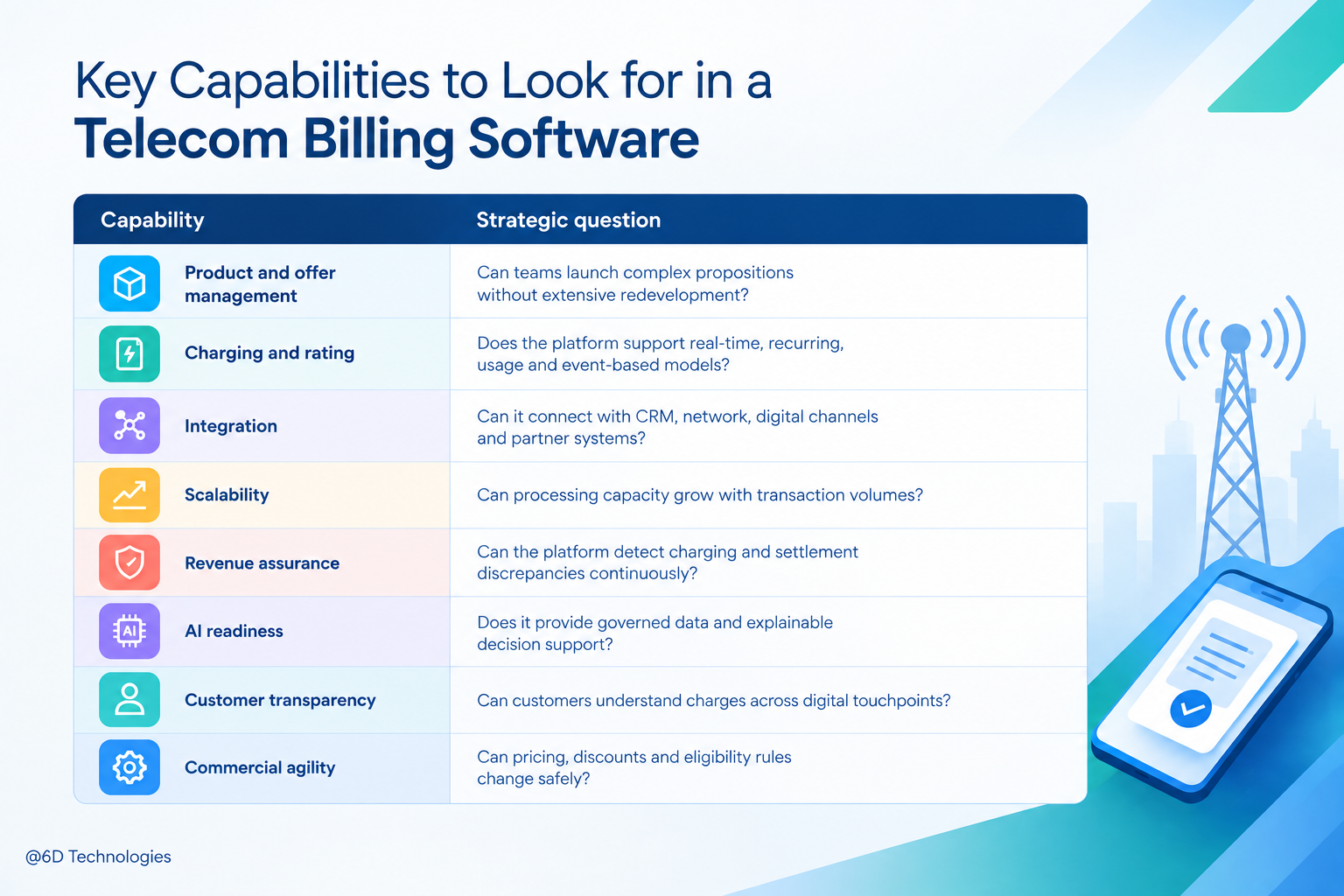
The strongest telecom billing software companies should function as part of a broader commercial operating model. It should not become another isolated application within the BSS landscape.
9. What Telecom Billing Software Companies Must Rethink
The market is moving toward integrated platforms rather than narrowly defined billing engines. Vendors must therefore reconsider their product strategies.
First, charging should become more configurable. Operators need reusable rules instead of custom development for every new proposition.
Second, billing should connect more closely with customer intelligence. Pricing decisions should reflect customer value, usage behavior, and service context.
Third, platforms should support diverse ecosystems. Digital services increasingly involve partners, marketplaces, APIs, and enterprise platforms.
Finally, vendors must make modernization practical. Operators cannot replace every legacy component simultaneously. Incremental migration, open integration, and coexistence capabilities are essential.
These priorities distinguish a future-ready telecom billing software solution from a conventional billing application.
FAQs:
How can telecom billing software support 5G monetization?
It can support differentiated pricing, usage-based charging, enterprise commitments, and service bundles. Its effectiveness depends on integration with product, policy, and network systems.
What role does AI play in telecom billing software?
AI can identify anomalies, improve forecasting, prioritize disputes, and support commercial optimization. Governance and explainability remain essential for sensitive revenue decisions.
Can telecom billing software support IoT and enterprise services?
Yes, when it supports diverse event types, account hierarchies, usage models, and partner settlement requirements. These capabilities are important for complex digital service portfolios.
Conclusion:
Telecom billing software is becoming a strategic layer that connects commercial intent with operational execution.
The digital BSS era requires operators to monetize services faster, manage complexity more effectively, and deliver transparent customer experiences. These outcomes depend on the architecture beneath every offer, transaction, and invoice.
The future belongs to platforms that integrate charging, product management, customer intelligence, and revenue assurance. They must support both today’s connectivity services and tomorrow’s digital ecosystems.
Key takeaways:
- Billing architecture must evolve beyond transaction processing.
- Commercial rules should be reusable, configurable, and governed.
- Real-time charging supports diverse digital monetization models.
- Cloud BSS requires modularity, integration, and scalable processing.
- AI creates value when supported by reliable data and controls.
- Revenue assurance must operate continuously across the ecosystem.
- Customer transparency should be built into billing design.
- Platform selection must prioritize commercial agility and modernization.
For operators seeking a stronger foundation for digital monetization, 6D Technologies offers integrated capabilities across digital BSS, customer value management, sales and distribution, IoT, and AI. Its solutions help telecom businesses build more connected and adaptable commercial operations.